Under the Influence

Here in East Tennessee it has been raining more than usual for July. My parched yard and I are most grateful. Last week it was raining cats and dogs, as we say around here, and we had the biggest rainbow arch–completely across the sky–that I have ever seen. It looked to me as if we were experiencing a miraculous gift in a time and place in need of homegrown magic.

Coming from hardworking people who never really got ahead, I have always known I would need to make my own way in life. However, despite weathering divorces (plural), rearing children (mostly alone), and working in an ulcer-inducing job for 19 years, my life has nevertheless been full of laughter, books, music, travel, and the most welcome sound in the world: a throw-back-his-head laugh from my 9-month-old grandson.

But having kicked around this planet for more than a few decades, I admit that I agree with the Australian comedienne Hannah Gadsby I watched the other night on Netflix who said she identifies as tired. Right there with ya, sister. It is a disconcerting time to make sense of our country and world. I want to give up, throw my hands up, go the manager’s desk and say I am taking a much-needed breather. Yet there are people who are counting on me, and I cannot give in to the despair of what we have been living through for the past year and a half of the Trumpian dynasty.

Everyday the national news ranges from mildly upsetting to earth-shatteringly sad and troubling: babies and small children taken from their immigrant parents; dictators are applauded, our Cold War allies are called our enemies; black is white, good is bad, and shades of gray are nowhere in sight.

I have given much thought about what we can do to keep up our spirits, move forward, and bring joy to the lives of people we care about. What continues to inspire me to find a way to be me–in addition, of course, to my delightful grandson, Lincoln? Music, books, movies, and, most especially, people who have shared their experiences and told their stories through music, books, movies, and documentaries.

One of the people who inspires me the most is Fred McFeely Rogers, also called Mr. Rogers once featured weekly on PBS children’s television. A few weeks ago I saw two documentary films about him: “Won’t You Be My Neighbor” and “Mr. Rogers and Me”. Both movies feature the work and thoughts of Fred Rogers who had a long-running weekday PBS television series, called Mister Rogers’ Neighborhood from the late 1968-2001. Mr. Rogers was also an ordained Presbyterian minister and his mission was to help children know they are loved just the way they are and therefore capable of loving. I watched Mr. Rogers’ show with my sons in the 1980s and ’90s, and I think I loved watching it more than my children did.

In the film “Won’t You Be My Neighbor”, the interviewer asked people from Fred Rogers’ life to do something Mr. Rogers often asked people to do: take a minute to remember the person who loved them unconditionally and made them feel capable of loving and being loved. “All of us have special ones who have loved us into being,” he said. I immediately thought of my father, and how, under the influence of his love, I was loved into being me.

Adventure

Adventure: an exciting or remarkable experience; to proceed despite risk.
[From the Merriam-Webster’s Collegiate Dictionary, 11th Edition]

When I was born, Daddy was 22 years old and unemployed. To pay our small family’s bills, Mama returned to her job working at Great Atlantic Shoe Co., on Western Avenue in Knoxville, while Daddy cared for me. Of course, he had no experience caring for an infant since he had been an only child and virtually an orphan. I can only imagine his befuddlement as he tried to figure out how to keep me happy, fed, diapered (with cloth diapers!), clean, and alive until Mama came home from work.
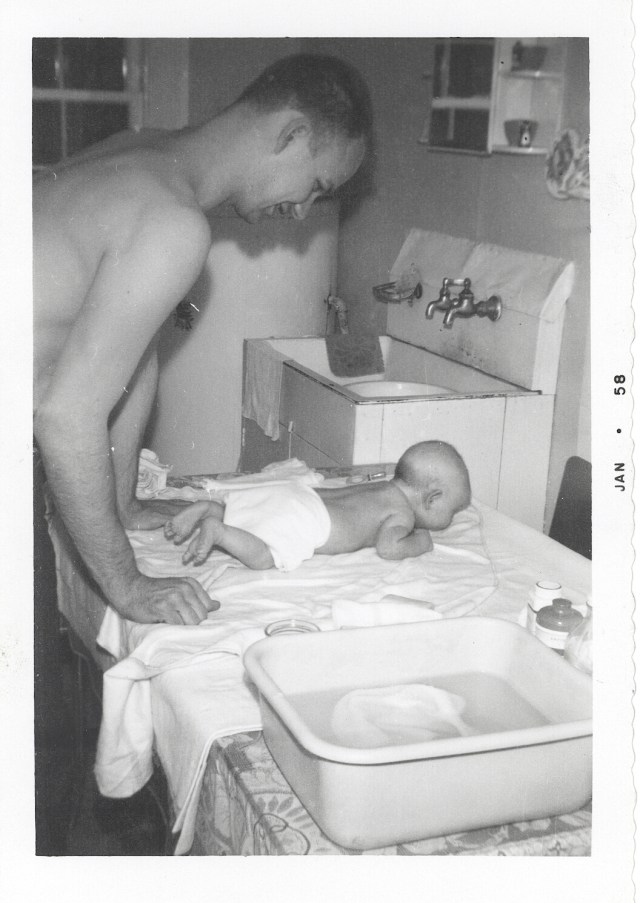
Anna Baby & Roy

Daddy giving me a bath when I was a baby, January 1958.

Fifty-eight years later, my father passed away on December 2, 2016. Daddy had slipped and broken his hip, successfully survived surgery to replace it, but had suffered a heart attack while sitting on an exercise bike during one of his physical therapy sessions at a rehabilitation center.

Before his accident, I helped Mama care for him at the senior living facility where he lived. After his evening meal Daddy would tell me, “You better get home before dark.” Even with his dementia, he never stopped being my Daddy, never stopped loving me, and never stopped looking out for me.

Daddy’s mother died with pellagra psychosis just 4 months after he was born. Her extended family told us that she was never able to even hold her infant son. Daddy was reared by his paternal grandmother who died when he was 5 years old. His father remarried twice, and his second stepmother threw him out of his home when he was a teenager. For a time he lived at the Downtown Knoxville YMCA.

Despite his abusive and neglectful childhood, Daddy taught me the things that really matter in life: simple, little things mean a great deal, people are more important than things, rich people without good values are not to be envied, and we should embrace life with open arms. Daddy taught me to live life as an adventure–not because he always was able to do that, but because he somehow found a way to live his life as much as possible with a child-like exuberance that was infectious and impossible to deny.
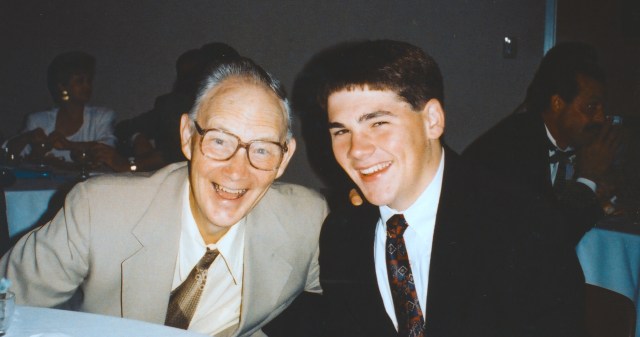
JustinScan-160107-0021

Daddy with his beloved grandson Justin in 1996.

He never completed high school or earned much money. He lost every job he ever had–except the last one which allowed him to work in a family business who allowed him to be his quirky, perfectionistic, take-your-time-and-do-it self. Daddy’s father could not read or write and never owned a car, but my parents traveled around the world with their beloved Lady Volunteers basketball team. Mama and Daddy successfully reared two girls who could make their own way in the world, and Daddy was an adoring surrogate father to my son Justin after I divorced Justin’s father when he was only 2 years old. Daddy ceaselessly encouraged me to be me. When he loved someone, it was a full-time job with no slacking.

On his television show Mr. Rogers told children, “I like you just the way you are.” He said it is essential for a child to have someone in their lives who treats them as if they are loved without reservations, with no need for renovations and a new paint job.

Daddy did that for me.

Balance

Balance: flexibility, stability, the ability to stand in the center of competing forces and not fall down. [My own definition]

Under the influence of my nephew Zach I have learned to be more understanding of others and yet to pursue my own course–at the same time. Zach is the foremost Zen practitioner I have ever known. Being a pleaser and lover of harmony, I will go out of my way to accommodate everyone around me to the detriment of my own well being. It is not a healthy trait, but one that exhausts me.
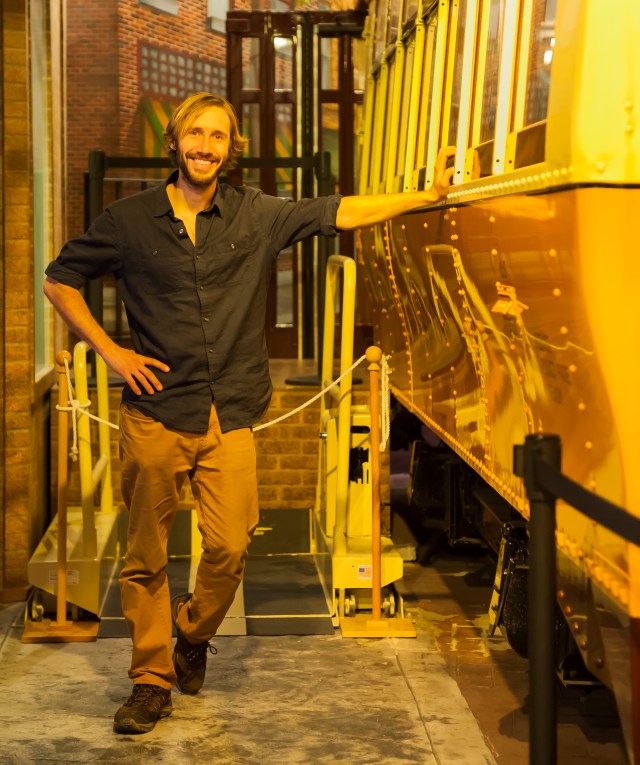
Zach Trolley December 2014 copy

My much-adored nephew Zach who has taught me sooooo much. He is one of my best friends. Photo: Kurt Weiss Photography

Sitting at a coffeehouse, patiently reading a book. Waiting, just being at home with himself. That’s Zach. Currently he is working on a master’s degree at the University of Kentucky, teaching graduate-level classes as a graduate student, doing his research, and still finding time for reflection as he bicycles around Lexington and cares for his partner in life–warm, loving, beautiful Paige–and their two dogs. He knows how to set limits with others in a beautiful, honest way, and yet is one of the most caring and attentive friends I have ever had.

As Mr. Rogers said, “The best thing you can offer anybody is your honest self.” Thank you, Zach, for teaching me how to do that.

Curiosity

Curiosity: a sign of intelligence, a compelling desire to know for yourself and to experience for yourself. [My own definition]

Living life with wide-eyed wonder is what I practice in the presence of my 9-month-old grandson Lincoln. He intently studies the birds flying by our front porch, and watches the cars and trucks and listens carefully to the sounds they make. While holding to the side of his playpen, he bobs up and down to the ’80s music I play for him. He is transfixed by the wreath on the front door, is delighted by my green spatula with the wooden handle, and is fascinated by the metal HVAC vent cover on the floor.
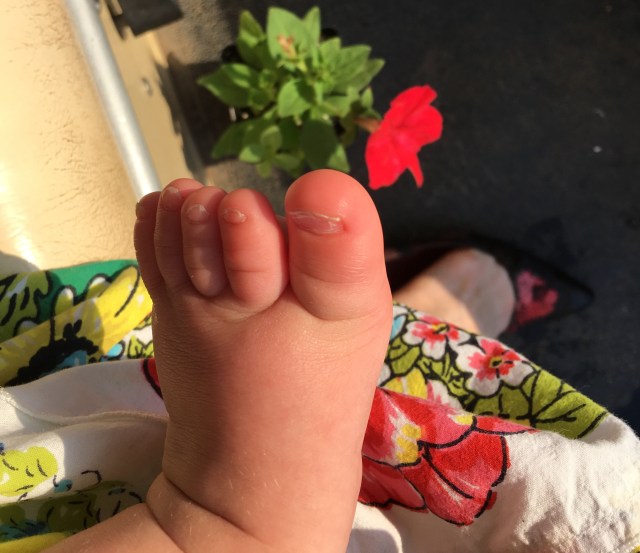
Little Man's foot during Stanley's adventure - 7-26-2018

Where this sweet foot will go we don’t know, but I hope to be there beside him.

When he was born last year, Lincoln had big hands and feet for such a small body, so I began to call him Little Man. He is indeed an old soul who studies carefully the people around him. He wants to understand everything he sees, hears, and tastes and is thirsty for knowledge and experience.

Little Man and I are content to simply look together in the same direction and observe the trees swaying in the breeze. We cannot see the force that makes the trees move, but we can hear the noise as it moves the leaves and branches. Lincoln teaches me to see with new eyes, to look with wonder and delight at everyday things, and to find solace in the silence together.

As Fred Rogers said:

When I say it’s you I like, I’m talking about the part of you that knows that life is far more than anything you can ever see or hear or touch.

Dreams

Dreams: imaginative manifestations of deep desire; to dream: the ability to imagine what could be instead of what is. [My definition]
Dreams: visionary creations of the imagination. [Merriam-Webster’s Collegiate Dictionary, 11th Edition]

Sometimes when you want to imagine a way forward, it is best to consider where you have been. A few years ago gifted singer/songwriter John Mellencamp did just that as he decided to record an album in the same manner (in mono, not stereo tracks), on the same equipment, and at some of the same locations as classic musicians of the 1930s, ’40s, and ’50s. In those decades before overdubbing and multiple tracks, musicians and singers would gather around a single microphone with only one or two takes to capture the sound.
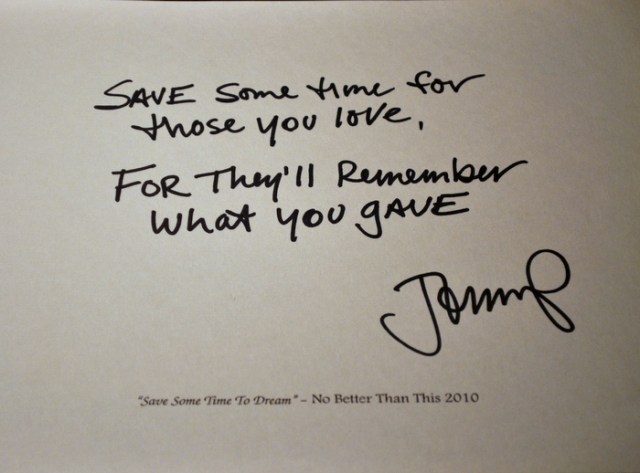
John Mellencamp signature

John Mellencamp’s handwritten encouragement from his song “Save Some Time to Dream”. Download from forum.mellencamp.com

According to Wikipedia, Mellencamp wrote 30 songs and chose 13 of them for the album he called No Better Than This. He debuted my favorite song from the album Save Some Time to Dream in 2009 at an event for President Barack Obama saying, “It’s about individual freedom and thought—and controlling our own lives”.

When I was growing up in a family buffeted by a succession of employers who found Daddy’s work abilities wanting, I yearned more than anything to grow up and have control over my life. I dreamed of living a better life than the one my family lived.

Anna & Lisa

My sister Lisa (right) and me (left) at a Mother’s Day picnic, May 14, 1961. My dress is a too little and so are my bangs!

Save Some Time to Dream – by John Mellencamp

Save some time to dream
Save some time for yourself
Don’t let your time slip away
Or be stolen by somebody else
Save some time for those you love
For they’ll remember what you gave
Save some time for the songs you sing
And the music that you’ve made
Could it be that this is all there is?
Could it be there’s nothing more at all?
Save some time to dream
‘Cause your dream could save us all

Save some time for sorrow
Cause it will surely come your way
Prepare yourself for failure
It will give you strength some day
Try to keep your mind open
And accept your mistakes
Save some time for living
And always question your faith

Could it be that this is all there is?
Could it be there’s nothing more at all?
Save some time to dream
‘Cause your dream might save us all

Cast your eyes up to heaven
Oh what does that mean to you
Try not to be too judgmental
So others will not judge you
Save some time to think
Oh before you speak your mind
Many will not understand
And to them you must to be kind

Could it be that this is all there is?
Could it be there’s nothing more at all?
Save some time to dream
‘Cause your dream might save us all

Oh yeah
Your dream might save us all

Copyright – John Mellencamp

I have been under the influence of John Mellencamp’s music since he burst on the music scene in 1980 with the song Ain’t Even Done With the Night which I watched him perform on TV. Channel his musicianship if you are looking for the finest Americana music written and sung by a consummate musician who has never forgotten where he came from. His music and words continue to encourage me to imagine a future where the past informs and illuminates.

Education

Education: to develop mentally, morally, or aesthetically, especially by instruction. [Merriam-Webster’s Collegiate Dictionary, 11th Edition
Education: to formally or informally learn from the experiences of others as well as from one’s own. [My own definition]

Seeking to be an educated person was certainly not a popular notion when I was in high school, but I decided early on that I wanted very much to be one of those individuals who reads and hears the experiences of others, studies the alternatives, and decides for myself what is truth for me. Knowledge was my goal, and education would be my transport to a better life. I wanted to find a better way.
One way to be educated is to be able to discern what is important and what is not. As the author Jeanette Winterston write, “Why are the real things, the important things, so easily mislaid underneath the things that hardly matter at all?” It seems to me that to be truly educated is to know the difference between what is essential, what is nice to have, and what is trivial and not worth the effort at all.
Found
Found: to discover that one is well at home with oneself. [My definition]
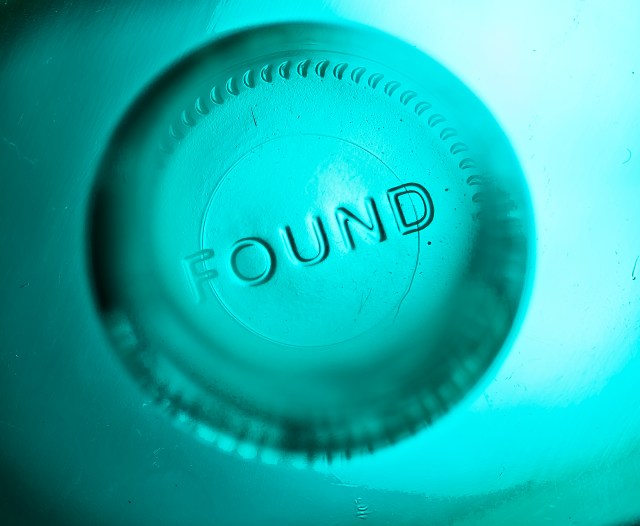
Found - 028

The under side of a flavored water bottle as photographed by my husband, Kurt Weiss.

When I started writing this blog five years ago, I decided to call my efforts Found Objects Creative. Why? Because I am fascinated with the process of taking something rather ordinary and repurposing it–reimaginating it, creatively–into something altogether new. I submit to you that we can do that with our lives.
Taken together then, the foundation building blocks of moving forward with joy despite the odds include: adventure, balance, curiosity, dreams, education, and the alchemy of mixing them together to find your own way. You may swim against the current, sometimes alone, but keeping your head above water by recalling the stories of others who have come this way before and shared their thoughts, signposts, and experiences.
There is a process called annealing where a metal or other material (such as glass or steel) is heated or set on fire. It is then allowed to cool causing it to be stronger, tougher, and less brittle. Perhaps this is the time of our annealing, and we must travel this road to become more fully what we can be as a community. I pray it is so.
However, I’m no Pollyanna, and I must admit the forces of evil, disunion, ignorance, and superstition are often stronger than I can my forces of imagination can fight. But I am not alone, the example of others urges me onward. I am eternally grateful for the people who inspire me and go with me on my adventure.
May we be found, together.
~ Anna 7/31/2018
Posted in Autobiographical, Books, Childhood, Courage, Education, Family, Friends, Happiness, Ideas, Knoxville, Music, Op/Ed Thoughts, Tribute, Uncategorized, Wonder, Writing | Tagged , , , , , , , , , , , , , , , | 1 Comment

Backyard Excavation

Our new Victorian home, originally built in 1910, in April 2018.

After 15 years in a house we loved but that had grown too large for us, we decided to downsize and drag fewer possessions through life. We wanted to move to an area (1) we could afford, (2) in a neighborhood with sidewalks and businesses within easy walking distance, (3) in the central area of town. Fat chance!

Properties in the downtown area proper were seriously overpriced, so after many blind-date visits to houses that were not us we were looking at lots to buy. Walking with our real estate agent in the Old North Knox neighborhood, we passed a Victorian, two-story home with a For Sale sign in the yard. We learned the home was in the final stages of renovation by a local house flipper. After winning the bidding war over two other bidders, we moved March 3 to this old-growth, tree-lined neighborhood called the Old North Knoxville Historic District that was originally incorporated in 1889.

Our Southern front porch.

We are not the only people seeking to live in an updated Victorian or Craftsman house or bungalow  built during the early part of the 20th Century. Our built-in-1910 house suits us in many ways, though it would have suited us even better at a lower price! But houses in established neighborhoods such as Old North Knox, the nearby Fourth and Gill area, and South Knoxville’s Island Home community are hot, pay-over-the-appraised value commodities–and we did.

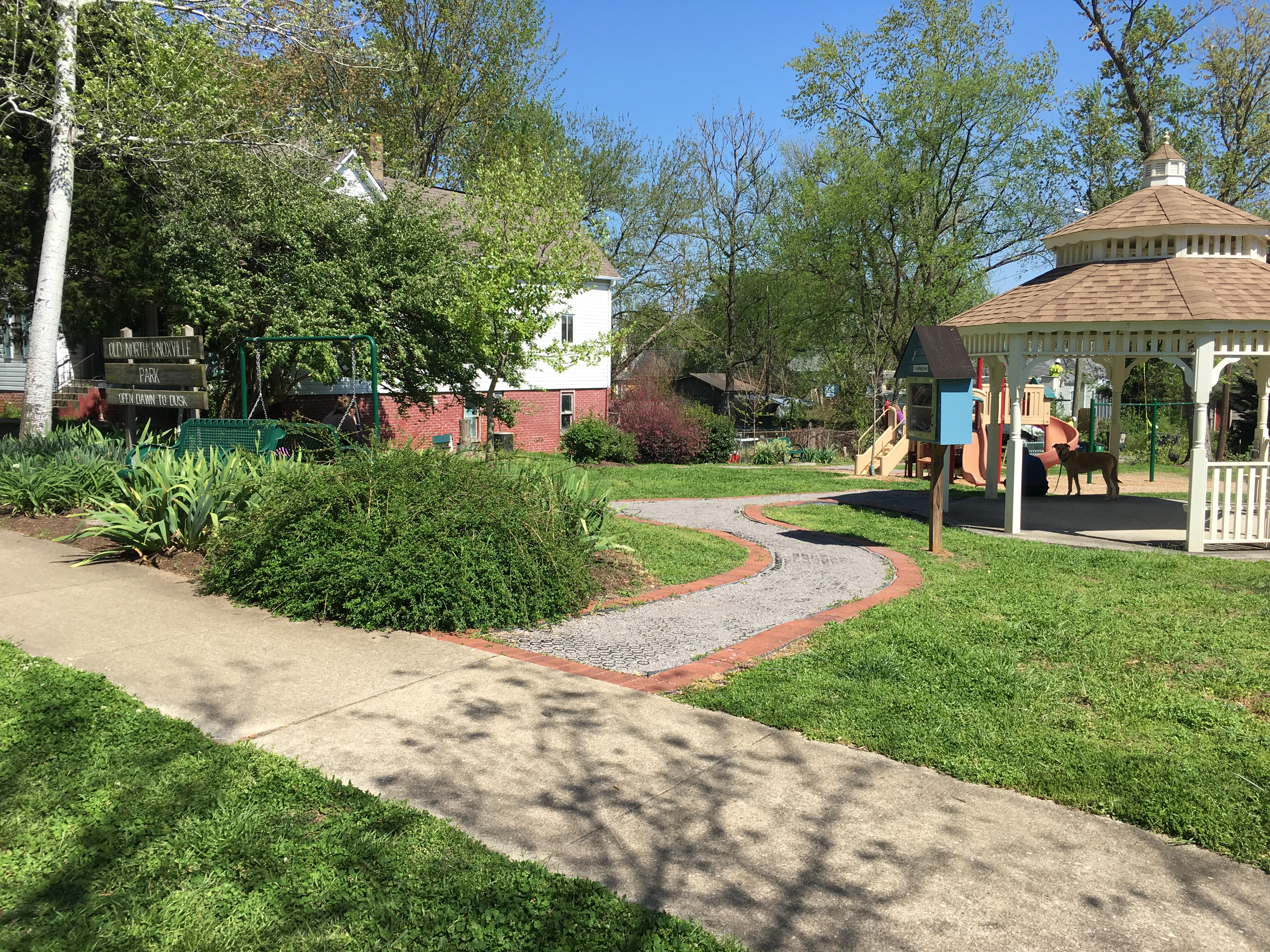
Compensating for their inconvenient lack of an attached garage or carport, these older houses dating to the late 1800s and early 1900s feature the livability factors–sidewalks, bike lanes, community, biiiiiggggggg trees, a grocery store–that younger and middle-age home buyers want. We have a well-kept children’s park nearly across the street from our home, a Southern front porch, and a true neighborhood, none of which we had in our former home.

The park across the street from our house.

Of course alongside these pluses, we discovered more than a few downsides to our older home: standing water in the crawlspace; a muddy, nothing-but-straw backyard; not-enough cabinet space in the kitchen or closet space in general; no handrails for the front steps; paint already coming off that Southern front porch; water pouring into the master bathroom from a leaky room; and the cheapest toilets money could buy. Yowza.

Two glass bottle fragments found in the crawlspace under our house which was built in 1910 as well as dice from a Dungeons and Dragons game.

Between hosting various workmen, I have had quite an adventure uncovering treasures in our backyard and under our house. One of the members of the crack team who fixed our standing-water problem found vintage bottle fragments in the mud under our house. He presented me with a tiny glass bottle with a broken neck featuring Larkin Co. Buffalo embossed across its front and the neck of what could have been an early Coke bottle.

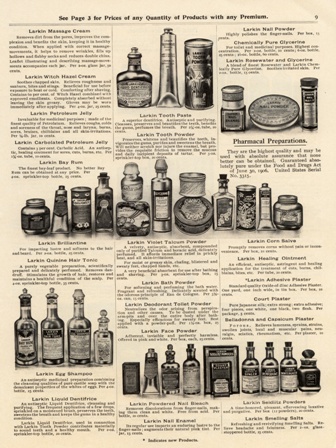
A quick search of the web told me the Larkin Co. was founded in 1875 in Buffalo, New York.

A page from the Larkin Company’s 1910 product catalog showing toiletries similar to the bottle found under our house.

The company was quite successful in its heyday when it was profitable enough to have the influential architect Frank Lloyd Wright design their headquarters building in 1903. At that time the company was a booming mail-order company–second only to Sears Roebuck & Company–with a national reach.

Larkin began as a soap company that cut out the middle man by selling directly to the consumer via door-to-door sales. Later they recruited women to market their products in the manner of Avon representatives. When they were known for the Larkin Look, the company sold everything for the home and family from furniture to toys.

The Larkin bottle found under our house was probably bought between 1910 and 1920 and contained a toiletry product such as a liquid tooth cleaner.

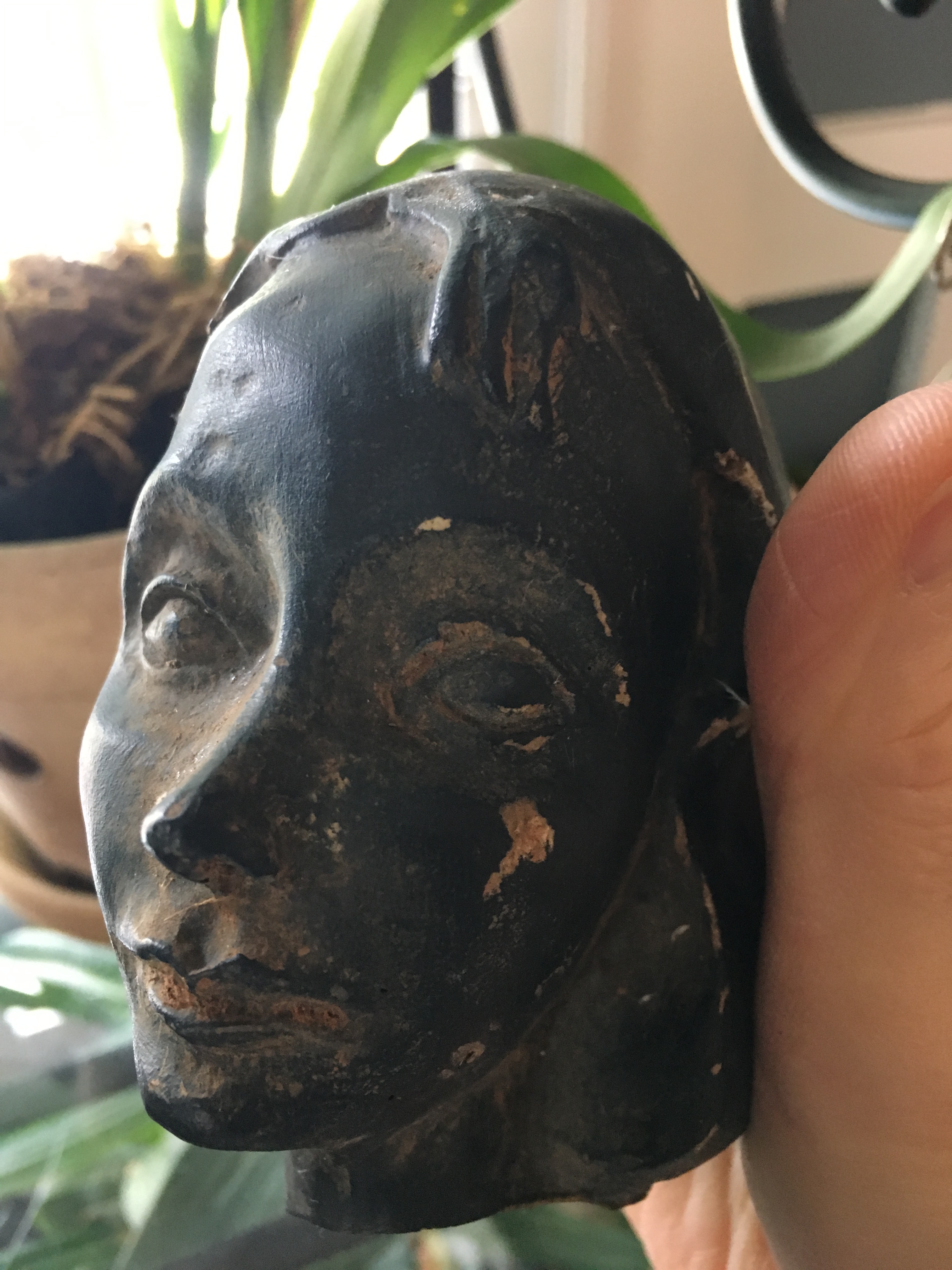
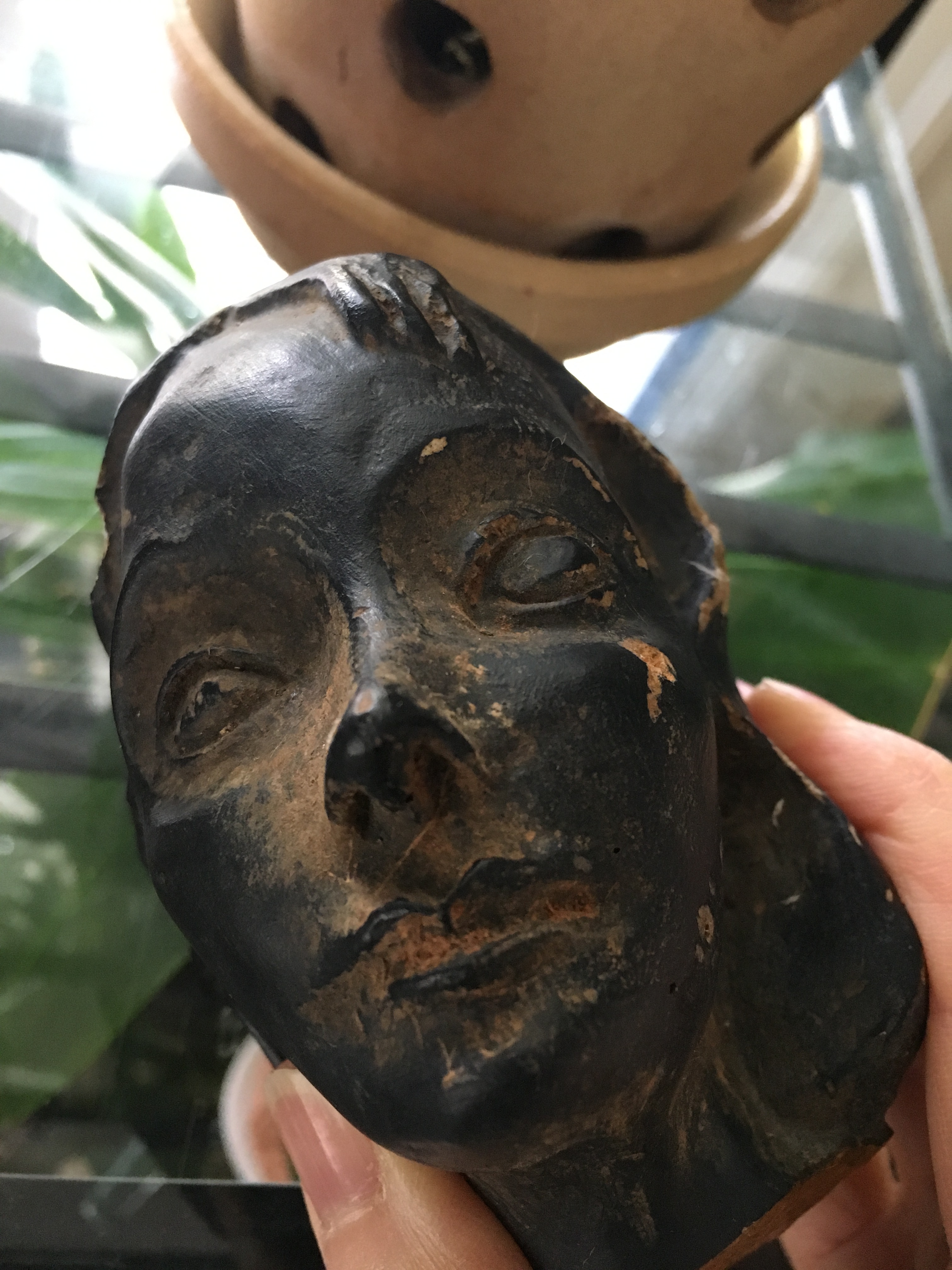
Each time I dig in our yard to add a tree, shrub, or plant, I never know what I will find: a windshield wiper blade, Dungeon and Dragons dice, bricks, cinderblocks, candy wrappers, plastic bag pieces, nails, screws, roofing material, and all manner of construction debris. By far my most unexpected find was just lying on top of the ground near our fence line: the head from a small statue of a woman.

A month or two after we moved in to our home, I found the head from a small statue of a woman in our backyard.

Despite her condition, I call my backyard treasure “My Lady” because she inspires me with her grace and serene beauty.

My Lady, as I call her, might have been originally made of terracotta. Although much diminished from whatever form she had when she was first made, My Lady has a singularly kind, regal, and peaceful quality. From different angles, she appears to show varying nuances of her personality. She is fragile, but she endures. She is broken, but she still has the strength of spirit to inspire.

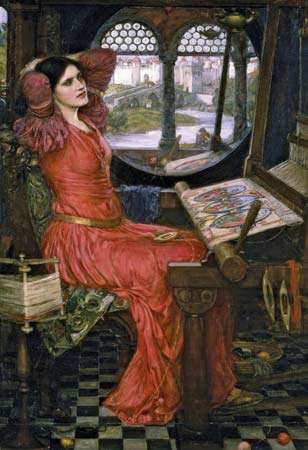
The painting “I Am Half Sick of Shadows” [said the Lady of Shalott], by John Williams Waterhouse, 1915, in the Art Gallery of Ontario, Canada.

Much as the ancient statues left from Greek and Roman culture that are missing arms, legs, or heads, my backyard find is not complete. Yet her proud carriage has weight and presence nonetheless. However, I have not yet found an appropriate way to exhibit her since, after all, she does not have a body to stand on.

She puts me in the mind of a few lines from the poem, The Lady of Shalott, written by the much-loved Victorian (yes, just like our house!) poet Alfred, Lord Tennyson (1809-1892), and performed as a song by my favorite musician and songwriter Loreena McKennitt.

But Lancelot mused a little space;
He said, ‘She has a lovely face;
God in his mercy lend her grace,
The Lady of Shalott.

We are all broken somehow and in some way–although many would argue aggressively to the contrary: No problem here; nothing to look at; move along.

The Lady of Shalott by John William Waterhouse, 1894, Leeds Art Gallery, Leeds, UK.

Grace is the quality I aspire to. To be gracious is to embody kindness, compassion, empathy, caring, and love whether in thought, word, or deed. But perhaps grace is beauty in action. Grace is love in action.

In Tennyson’s poem, the Lady of Shalott says, “I am half sick of shadows” which is a reference to a curse placed upon her in which she cannot see the world directly but must look at it through a mirror–and one would imagine, with distortions and darkly. However, the Lady of Shalott looks directly at Lancelot (of the Arthurian legends) as he rides to Camelot which breaks the mirror and allows her to see him clearly with her own eyes. And then she dies. Yes, seeing clearly can be dangerous.

These days in the second year of the reign of our country’s new sheriff in town, I find it hard to look directly at the world with its crying immigrant children separated from their parents and a tweeting reality TV personality as our leader offending the allies we fought beside in two catastropic world wars.

I find no grace in our leader’s swaggering ego and his unending appetite for power. It is truly sad that our country swerves like an alcoholic veering wildly from left to right. For eight years, we had a President whose mother was a white American from Kansas and whose father was a black African. President Obama was elected not once, but twice. So in the following election, an Electoral College majority (not the majority of the Americans who voted, mind you, but 3 million voters less) decided we needed a man who makes white men feel they are still in full control. When were they ever not? Even with a black President, the pale-faced men in Congress made sure he could only do so much.

The skies over the gorgeous state of Utah where we visited my cousin last year.

Me? I am a moderate. A practical, yet romantic dreamer of a moderate. Meaning, of course, that both extremes can take pot shots at you if you raise your head and say what you believe. But if I had to take an alcoholic swig and get in the proverbial car of state, I’d definitely come down on the side of liberty–with a strong dose of health care for all. As the French national motto says: liberte, egalite, fraternite. Personal freedom, equality, and fraternity. And I would add a profound tonic of protecting our environment and breathtaking natural resources for my grandson’s generation and the generations to come.

Last Monday my 82-year-old mother was hospitalized with a stroke that we think happened a few weeks before that. Her primary-care doctor sent us from his office directly to testing at the hospital, ordering an MRI, to be followed by an ultrasound. Yet, after the MRI that confirmed that Mama indeed had a stroke, the radiologist asked us to take her directly to the emergency room for further evaluation and possible admission to the hospital. After spending the entire afternoon and evening in the overcrowded and cacophonous ER, Mama was admitted to the “stable” stroke floor.

A tiny insect on the glass of our front door.

The next morning she was evaluated by a neurologist, physical therapist, occupational therapist, speech therapist, and the house doctor. They all agreed her stroke was “stable”, and we could take her home that day. She will need speech therapy because her ability to communicate in complete sentences was diminished considerably by the stroke.

A few days later my mother got a four-page letter from her medical provider, Humana, saying they were not going to pay for her hospital stay because, in their view, it was not medically necessary. Who is to pay for Mama’s hospital bill remains an open question.

My precious grandson.

In these strange times, I take refuge in the intricate beauty of small things such as the ethereally winged insect that landed on our front door. And most especially I take refuge in the smiling ear-to-ear joy of my (looking for a superlative-enough adjective to add here) grandson who defies my ability to find words for how special he is.

His eyes are open, his heart is sweet, he is innocent of the larger meanings, and I love looking in the same direction as him and considering the wonders of the world.

Through his eyes.


~ Anna – 6/26/2018


Posted in Autobiographical, Backyard Nature, Beauty, Family, Freedom, Happiness, Home, Ideas, Knoxville, Love, Music | 8 Comments

Big Hair, Blue Eye Shadow, and Cassette Mix Tapes

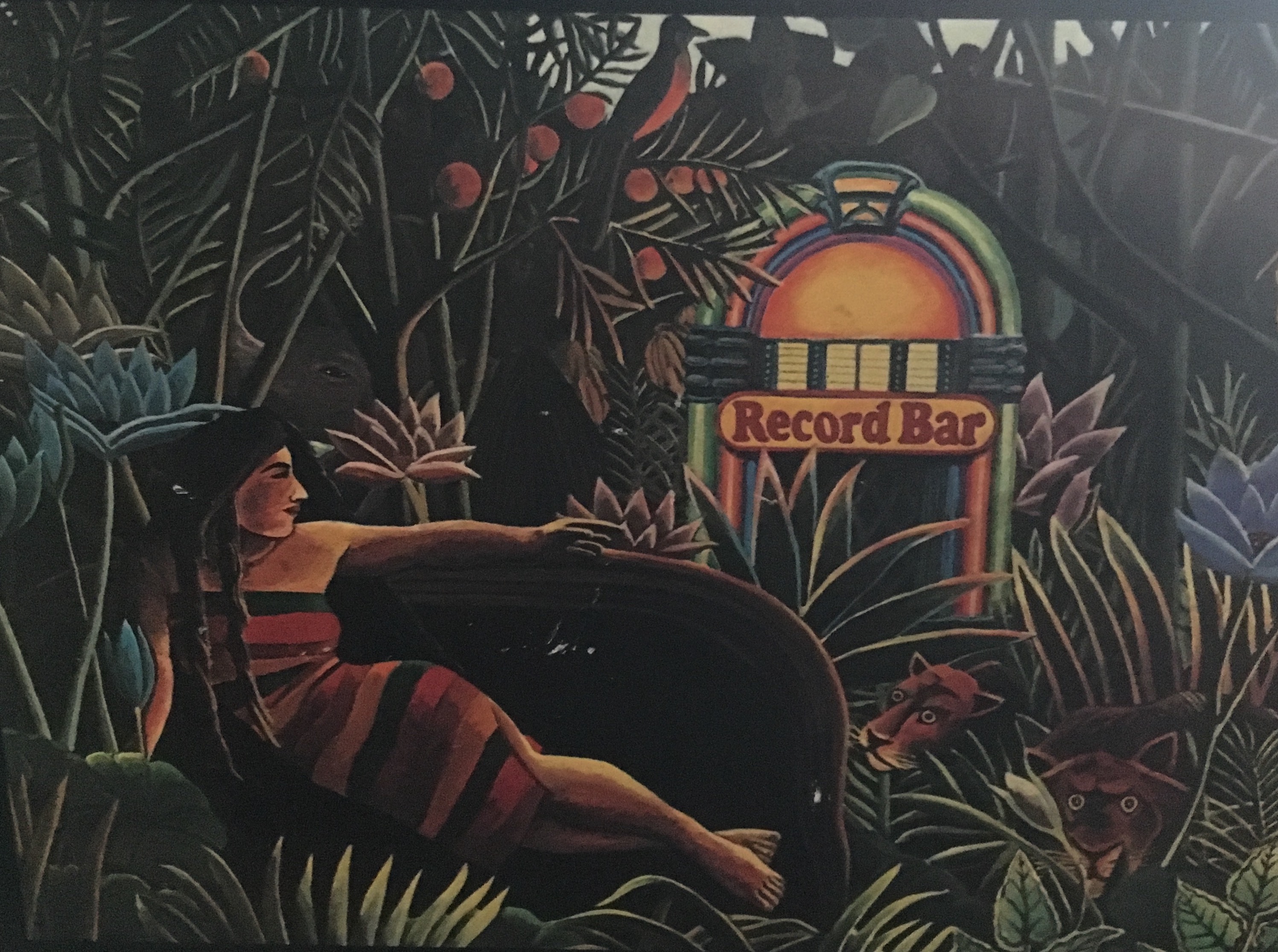
The artwork on the small wooden crate that holds my 45 rpm record collection.

In February when I was packing to move into our new house, I found my record collection of 45s in a wooden crate holder I bought at the long-defunct record store we used to go to called Record Bar.

For those of you who did not grow up during the heyday of vinyl records, 45 rpm (revolutions per minute) recordings were released by record companies from the 1950s through the 1980s. These 45s, as they were called, had two songs, an “a” side and a “b” side. The “a” side was the song the record company hoped would become a hit,  played in heavy rotation on the radio, and sell a lot of records; and the “b” side was a song thrown in as a bonus. Ever so occasionally the “b” side was a good song too, but not usually.

Not only do I still have my 45s from the late ’70s and ’80s, but I also have my LP (long-playing, 33-1/3 rpm) record collection, as well as the turntable I played them on. I do not remember some of these 45s at all. Maybe they were records once owned by friends or former boy friends, who knows. But some of these records are fantastic songs, feature amazing cover art on their protective sleeves, and are musical format that no longer exists.

From my experiences looking through 45s at vintage stores, beautiful artwork and lyrics must have began to appear on 45 rpm sleeves in the 1960s. Daddy had a large collection of 45s, but he kept none of the sleeves for his records. Instead he kept them in a set of specially sized albums.

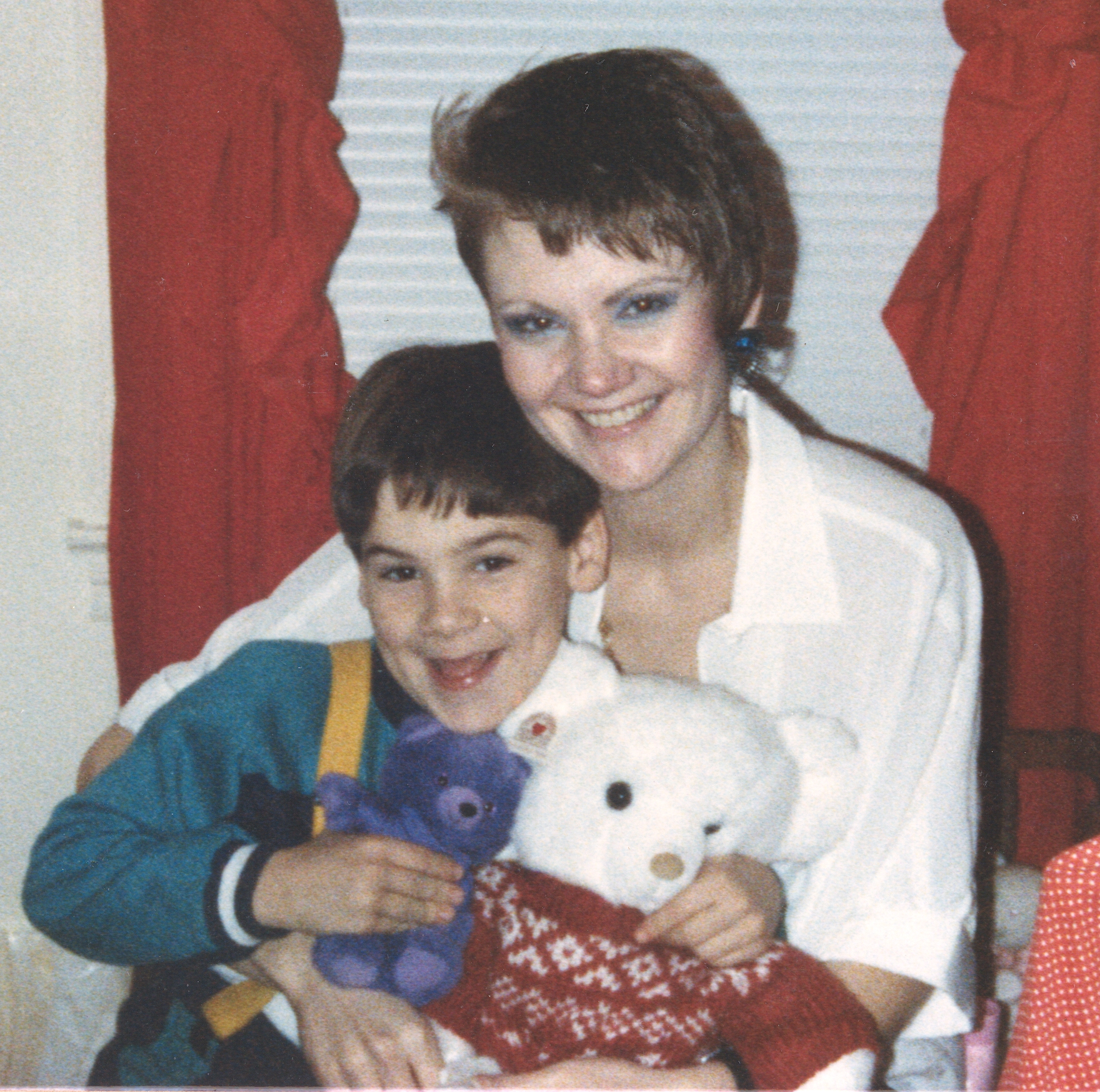
Here I am with my beautiful son Justin, epoxied hair and blue eye shadow, probably 1986.

Most of my 45s were bought in the ’80s when I was a divorced, single parent, working full-time, and going to college part-time.

As a quick way to catch up on the latest songs, we watched MTV (music television) videos which were a huge part of making hits and selling records in the ’80s. The visuals of these mini movies, married with driving dance music, made Madonna queen of the decade, along with British New Wave bands, and American “big hair” metal and rock bands. Big hair was not just for rock bands, however, we 20-somethings wore our hair bouffed up pretty high. I had, what my former boss dismissively called, epoxied hair, along with blue eye shadow, of course. Snapshots of me from that decade show both. Throughout the 1980s, I bought my favorite records on 45s, recorded them on cassettes, and listened to them religiously as the soundtrack of my life.

Here is the transparent back sleeve of Prince’s gorgeous 1980s anthem “Purple Rain” with the purple, 45 rpm record showing through. Simple, but highly effective artwork.

The king of 1980s music was the provocative genius of a singer/songwriter/guitarist, Prince. His song Purple Rain, recorded with his band The Revolution, was one of the three monster hits released from the soundtrack album for his hit 1984 movie of the same name.

Although the song’s lyrics are simple on their face, Purple Rain’s music combined with Prince’s singular guitar solo, was an electrifying anthem that inspired those of us who were young in the ’80s to live life with passion and not to settle for lives devoid of meaning and community. Timeless, then, the song continues to resonate today.

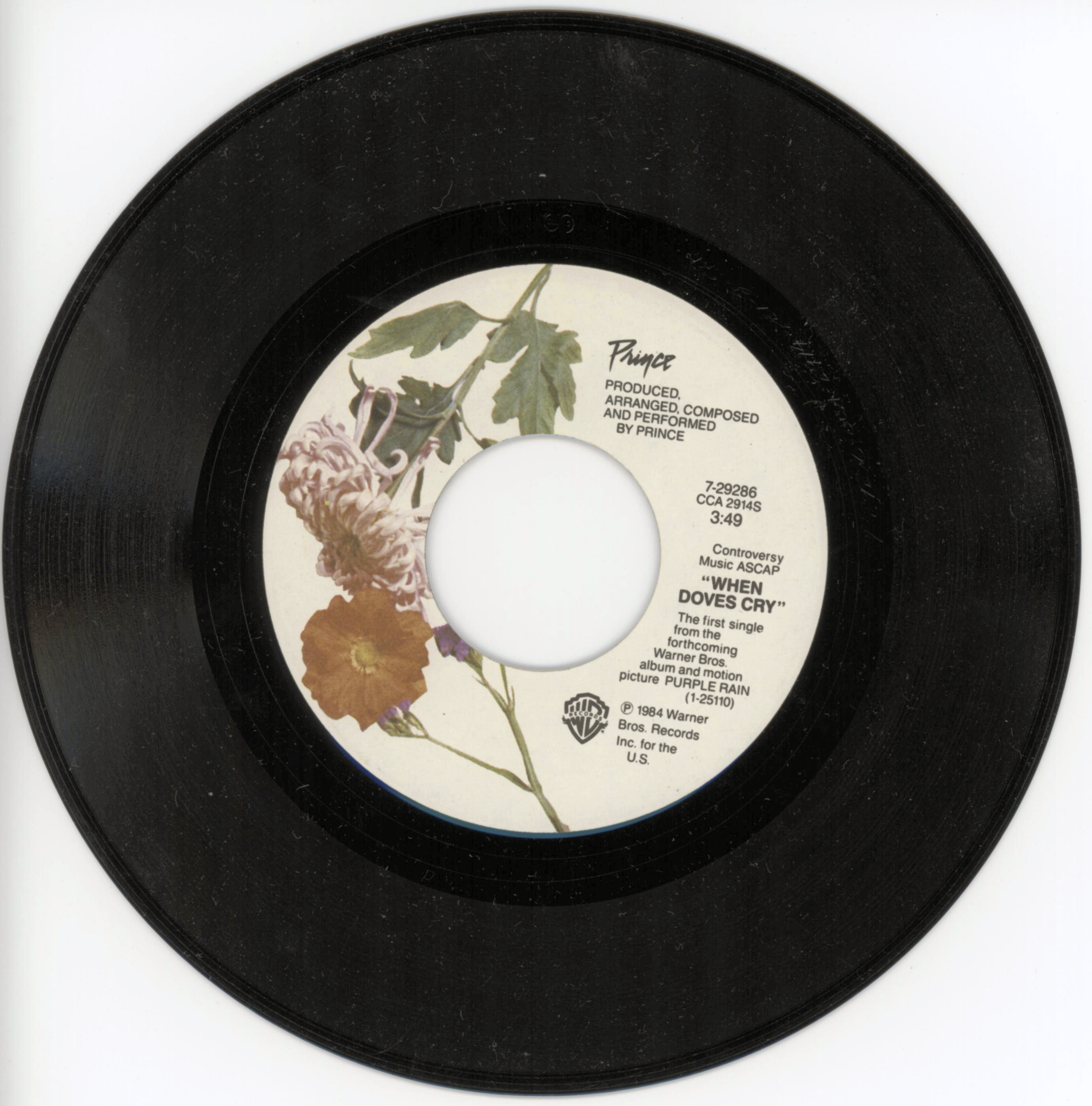
The label for the 45 rpm recording for Prince’s “When Doves Cry”.

Also in my 45 collection is Prince’s other hit, When Doves Cry, which hit number one on the singles charts that year along with Let’s Go Crazy–which was frankly not my cup of tea. I preferred When Doves Cry and its sumptuous video which inspired not just the record-buying public, but so many musicians who followed in Prince’s wake.

The matching artwork on the label and the back cover of the 45 sleeve, are standout examples of the cover art that is lost in today’s culture of streaming and downloading music.

The back sleeve of Prince’s single “When Doves Cry” which was released before the movie “Purple Rain” in which it is featured.

When I grew up in the ’70s and ’80s, we pored over the lyrics printed on record covers. I memorized the words, sang along with the music, and studied the list of musicians who played on each song.

Today song lyrics are available on the web, but the artwork and information contained in LP and 45 rpm liner notes are mostly not available to present-day music lovers, and much is lost without it. There are a few albums available on vinyl now, but not the majority. The music industry has never really recovered from the loss of its standard modus operandi of recording albums, releasing singles on 45s, and pushing radio play to score hits.

Also in 1984, British rock/New Wave group Talk Talk released their single It’s My Life that was also a big hit as a cover song for American ska group No Doubt in 2003. Although the lyrics are mostly about love, the song has always spoken to me about the freedom to live my life on my own terms, and not allow anyone else to define who I am. Hey, and it’s also a great song–both in the Talk Talk and No Doubt versions.

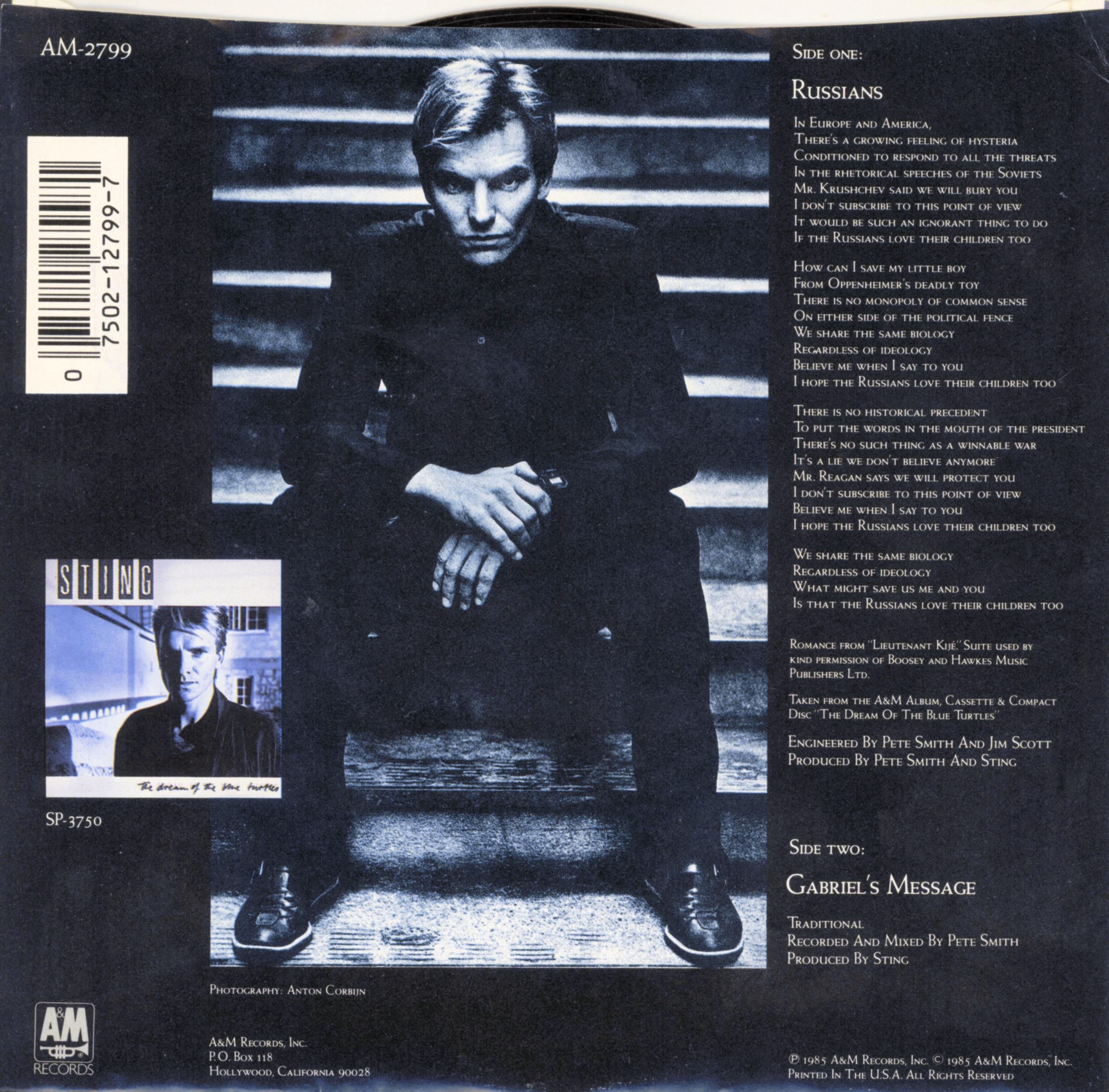
The back of the 45 sleeve accompanying Sting’s 1985 recording “Russians” which he co-wrote.

In 1985 British singer/songwriter/bassist Sting (real name: Gordon Sumner) co-wrote and released the song Russians. The recording has a gorgeous orchestral, wall-of-sound effect. Its powerful words are just as on-point today as they were during the Cold War era when the United States and the Soviet Union jockeyed for position as the world’s two superpowers. The last few stanzas of the song are especially timeless and true:

There is no historical precedent
To put the words in the mouth of the president?
There’s no such thing as a winnable war,
It’s a lie we don’t believe anymore.
Mister Reagan says, “We will protect you.”
I don’t subscribe to this point of view.
Believe me when I say to you,
I hope the Russians love their children too

We share the same biology, regardless of ideology.
But what might save us, me and you,
Is if the Russians love their children too

Songwriters: GORDON SUMNER, SERGE PROKOFIEFF
© Sony/ATV Music Publishing LLC

We do indeed share the same biology, no matter our beliefs or skin color. Sadly with nuclear proliferation today, we would need to add many more names to the number of countries, besides the U.S. and Russia, with nuclear weapons. And we continue to hope they love their children enough to allow them to grow up without the no-win-for-anyone outcome of nuclear war.

American band The Motels, originally from Berkeley, CA, released this hit single in 1982 on Capitol Records.

In 1982 the American New Wave group The Motels reached number 9 on the Billboard hits chart with their song Only the Lonely. Written by lead singer Martha Davis, the song had heavy radio rotation and spoke to me when I was a single striver. The 45 sleeve for the single features gorgeous art on the front as well as the back.

The reverse artwork on the 45 rpm single recording of “Only the Lonely” by The Motels.

This song perfectly evokes the 1980s decade as I lived it: a time of flux and transition, with more than a bit of backlash to the gains that women and minorities had achieved in the two decades that came before.

We had no Vietnam War to protest, and we did not stare at our navels in the way 1970s-era young people are accused. We tried to express ourselves with our clothes and, embarrassing to us now, our hairstyles, but we also fought to earn our independence in a similar way. And, as at anytime, that road can be a lonely one.

Only the Lonely

We walked the loneliest mile
We smile without any style
We kiss all together wrong
No intention

We lie about each other’s drinks
We live without each other
Thinking what anyone would do
Without me and you

It’s like I told you
Only the lonely can play

So hold on here we go
Hold on to nothin’ we know
I feel so lonely
Way up here

You mention the time we were together
So long ago well I don’t remember
All I know is it makes me feel good now

It’s like I told you only the lonely can play
Only the lonely only the lonely can play

Only the lonely only the lonely can play
It’s like I told you only the lonely can play
Only the lonely
Only the lonely can play

Songwriter: Martha Davis

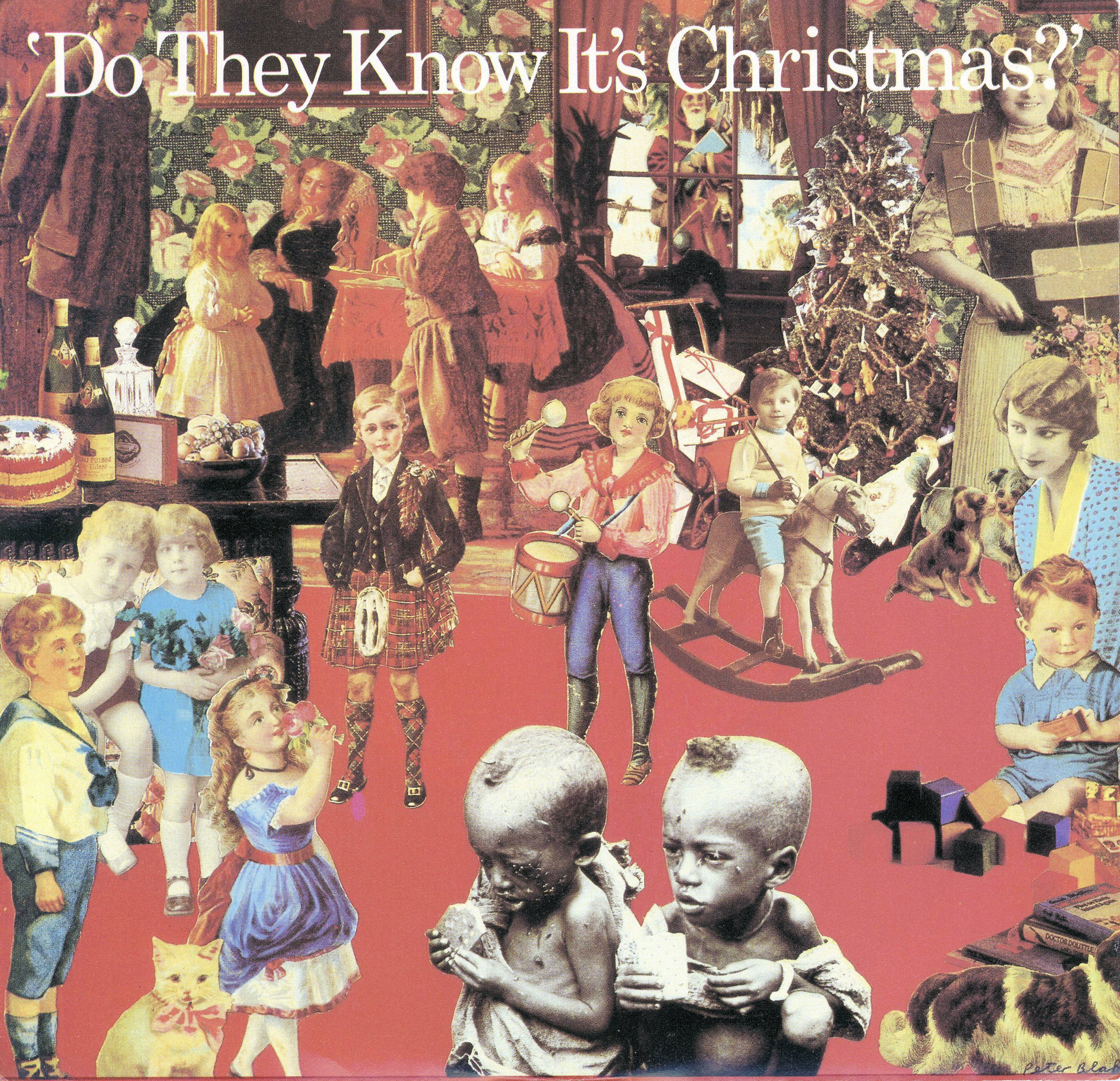
The cover art on the 45 sleeve of the Christmas 1984 recording “Do They Know It’s Christmas?”, a collaborative effort by top musicians to aid famine relief in Ethiopia.

In 1984 a group of British, American, and Irish musicians, called “the cream of the pop music talent” on the 45 sleeve’s reverse side, included Sting, Phil Collins, Paul McCartney, U2, and Wham. The musicians  collaborated on a song called Do They Know It’s Christmas? and released it under the name Band Aid just before the ’84 holiday season.

The recording’s proceeds (including merchandising, performance, and record sales) were donated to famine relief efforts  to help the starving people of Ethiopia. The artwork was as memorable as the effort was well known and highly effective, selling 2 million copies and raising $24 million. The song no doubt saved many lives and eased the suffering of thousands of destitute Ethiopians, and it was the beginning of a number of charitable recording collaborations in the following decades.

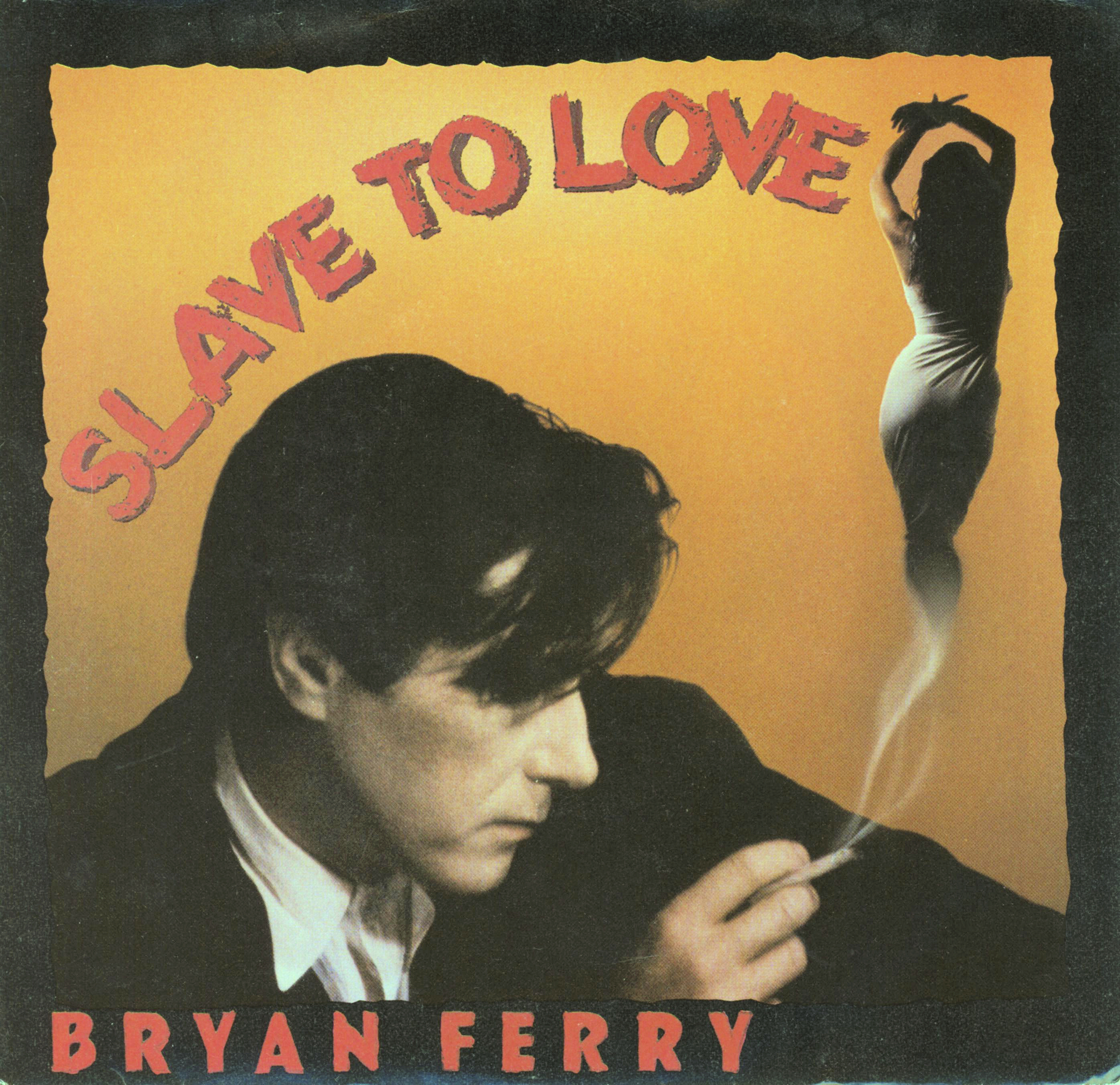
On its 45 sleeve cover, British singer/songwriter Bryan Ferry’s “Slave to Love” effortlessly captures the song’s mood and sensuality.

One of my favorite love songs of the 1980s was beautifully seductive Slave to Love, written and sung by British singer/songwriter Bryan Ferry. The video that accompanied its release in 1985 was a perfect accompaniment to the song.

Tell her I’ll be waiting in the usual place
With the tired and weary, and there’s no escape
To need a woman you’ve got to know
How the strong get weak and the rich get poor

Slave to love, oh, slave to love
You’re running with me, but don’t touch the ground
We’re the restless hearted not the chained and bound
The sky is burning a sea of flame
Though your world is changing I will be the same

[Chorus]
Slave to love, oh, slave to love
Slave to love, and I can’t escape
I’m a slave to love

Can you help me
The storm is breaking, or so it seems
We’re too young to reason, too grown up to dream
Now spring is turning your face to mine
I can hear your laughter, I can see your smile

[Chorus x3]

Songwriter: BRYAN FERRY
© EMI Music Publishing, BMG RIGHTS MANAGEMENT US, LL

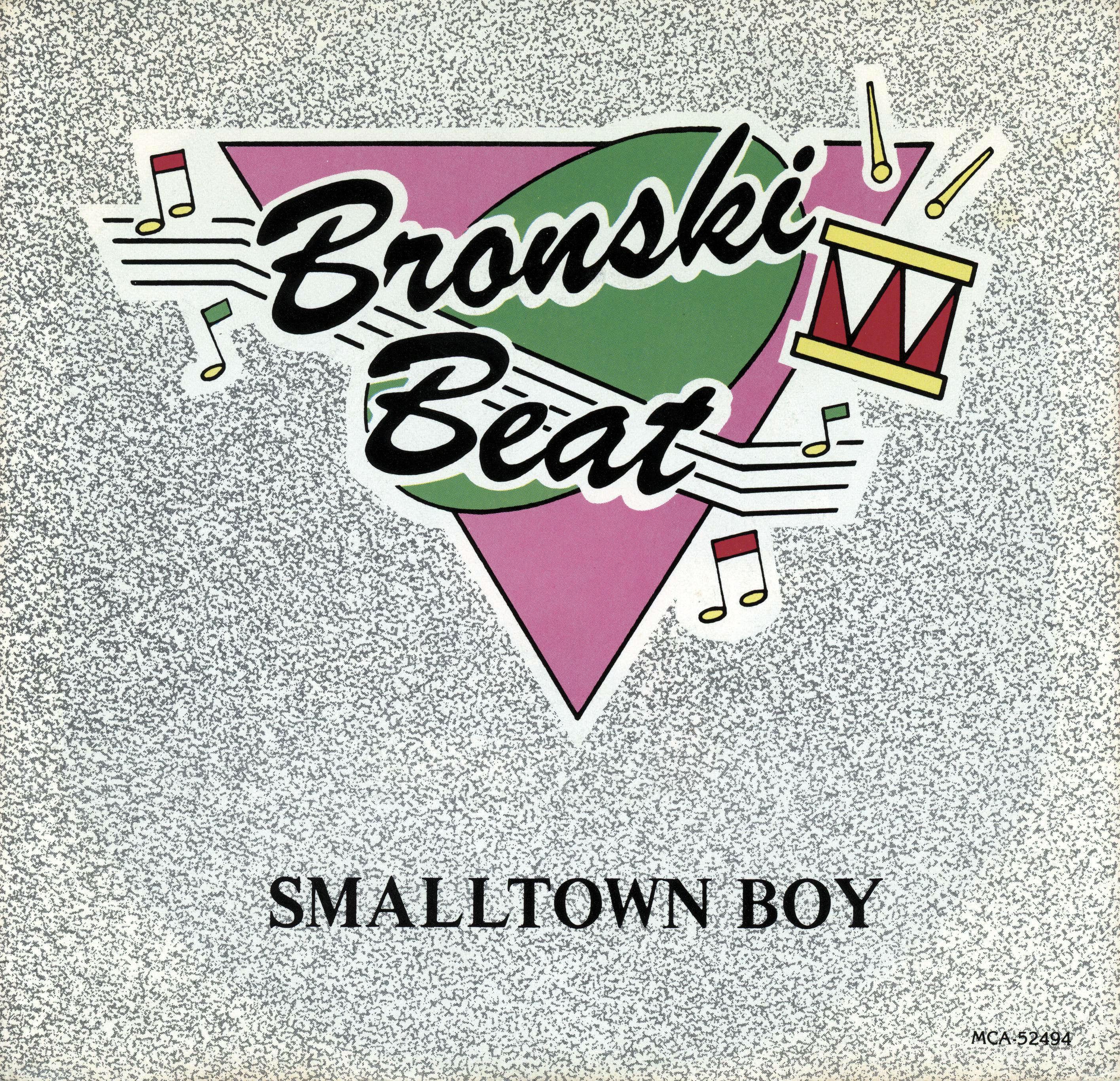
The cover of Bronski Beat’s 45 rpm recording of the song the trio wrote together and called “Smalltown Boy”.

In 1984, the British band Bronski Beat–with vocals by their lead singer, the divine vocalist Jimmy Somerville–released their recording “Smalltown Boy”.

Written by the three members of the band, the song can be easily understood by anyone who feels they are not completely understood or accepted in their family, hometown, high school, or by the people they grew up with. This song perfectly encapsulates the isolation of feeling unwanted, being an outsider, and seeking a place to be yourself and to truly call home. I spent a good deal of my early years and quite a bit of my life relating to this song.

Smalltown Boy

You leave in the morning with everything you own in a little black case
Alone on a platform, the wind and the rain on a sad and lonely face

Mother will never understand why you had to leave
But the answers you seek will never be found at home
The love that you need will never be found at home

Run away, turn away, run away, turn away, run away

Pushed around and kicked around, always a lonely boy
You were the one that they’d talk about around town as they put you down

And as hard as they would try they’d hurt to make you cry
But you never cried to them, just to your soul
No, you never cried to them, just to your soul

Run away, turn away, run away, turn away, run away (crying to your soul)
Run away, turn away, run away, turn away, run away

Cry, boy, cry
Cry, boy, cry
Cry, boy, cry, boy, cry

Cry, boy, cry, boy, cry

You leave in the morning with everything you own in a little black case
Alone on a platform, the wind and the rain on a sad and lonely face

Run away, turn away, run away, turn away, run away

Run away, turn away, run away, turn away, run away

Songwriters: James William Somerville, Larry Steinbachek, Steve Bronski

© Warner/Chappell Music, Inc.,Universal Music Publishing Group,BMG RIGHTS MANAGEMENT US, LLC

I simply love this song!

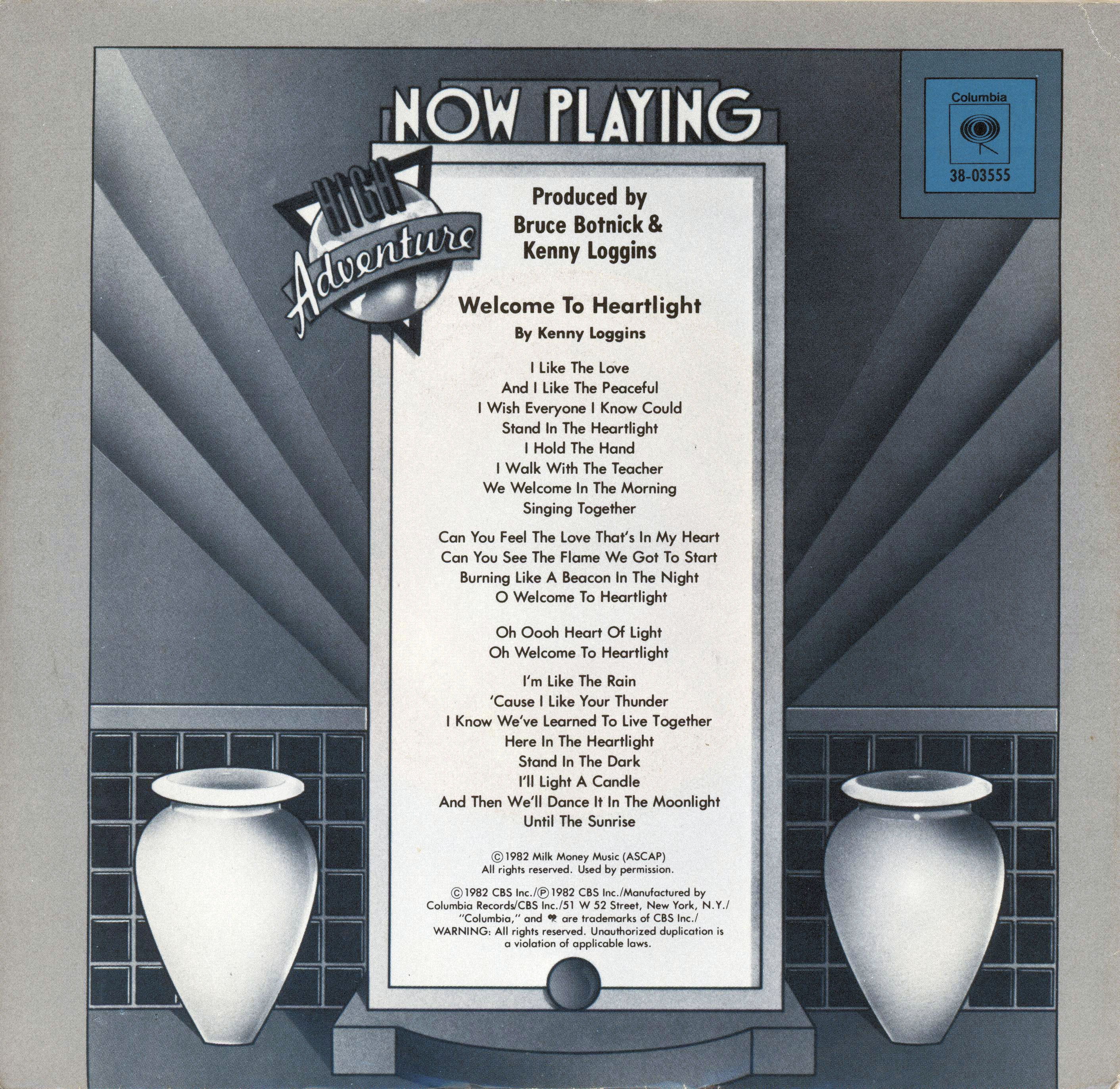
My current favorite song from my 45 collection is the one I sing now to my 7 month-old grandson: Welcome to Heartlight.

When I sing Heartlight to my grandson, he watches me intently, then beams, and starts bobbing up and down while holding onto the side of his playpen. He is completely irresistible!

Kenny Loggins was inspired to write this song by the writings of students who attended a school in Southern California called Heartlight.

Also in my 45 crate are the powerful rocking Love Is a Battlefield by Pat Benatar, The Right Thing by soulful Simply Red, Twilight World by Swing Out Sister, The Rose by Bette Midler, the ethereal and magnificent Life in a Northern Town by The Dream Academy, ‘Til Tuesday’s Voices Carry, Dress Me Up by Madonna, Crowded House’s Don’t Dream It’s Over, Quarterflash’s Harden My Heart, and maybe 70 or so more.

Although 45 rpm singles are not the music vehicles of choice anymore, the 45s I listened to in the ’80s are just as transportive now as they were then. Love, growing up, loneliness, finding my voice, trying to make a difference–that was me in the 1980s–and that’s still me in the 21st Century. Great music is the best companion for traveling the adventure of life.

~ Anna – 5/31/2018

Posted in Autobiographical, Creativity, Joy (Joie de General), Love, Music, Op/Ed Thoughts, The Arts | Tagged , , , , , , , , , , , , , , , , , , , , , , , , , , , , | 1 Comment

Settling Down While Still Flapping Around

During my only graduate-level writing course at the University of Tennessee, Professor Jon Manchip White, an ex-patriate from Wales as well as from Hollywood where he spent his screenwriting days, advised us that we would-be writers should keep a commonplace book filled with ideas we could use to inspire our work.

Apparently a practice that originated in Early Modern Europe, commonplace books in the 21st century can be filled with quotations, snatches of movie dialogue, song lyrics, overheard conversations, lines from books, titles, phrases–anything we want to remember for future reference.

During our recent moving process, I realized the idiosyncratic way I had taken Dr. Manchip White’s advice, as I packed and unpacked 15-20 of my commonplace books. The first few pages of each journal was marked with my handwriting and then nothing in the pages thereafter.

Life certainly has a way of taking me away from my best intentions of writing more often and even from regularly writing in my commonplace book. Inspirations come at me nearly every day, and my husband and I talk about how great a blogpost this or that idea would make. Then instead of writing, I chase my tail through the halls of my life, filling up the trash containers, taking out the recycling, washing ever more clothes, and cleaning the never-ending pollen from my front porch rail.

When we were in London for my husband’s work in the 1990s, we took the Tube (the subway system) around the city. It occurred to me toay that’s the Tube is what my life looks like to me. I am watching as the light flashes by at each Tube station, then the dark of the Underground tunnel, followed by the light of another station, then the dark tunnels interchanging until we arrive at my destination station, and I race off to my next errand. Clock’s a-ticking.

As I dashed through life in 2011–the year I was not-so-graciously encouraged to leave my 30-year job at the University of Tennessee–my commonplace book noted sound advice from American writer Mark Twain (1835-1910) who advised in The American Claimant:

Drag your thoughts away from your troubles–by the ears, by the heels, or any other way, so you can manage it; it’s the healthiest thing a body can do.

In any time or place, excessive study of our own belly buttons–rolling in the mud of our own bailiwicks–is just a disaster for a sound mind and spirit. My sister and I ascribe to the keep moving doctrine. No matter the aching muscles or bones that remind us we are aging, staying busy has kept us sane. Oh, most of the time.

From These Amazing Shadows, a 2011 documentary featuring some of the best movie treasures, I noted that Librarian of Congress Dr. James H. Billington (born June 1, 1929) said:

Stories unite people; theories divide people.

Certainly life in America and throughout the world in 2018, has proven Dr. Billington’s notion that telling our stories reminds us of our shared humanity and has the hope of bringing us together. Pontificating, pointing fingers, telling other people how to live, seeking to control people who speak, look, or worship differently has led humankind to war followed by war, followed by war, followed by war.

A page from my 2011 commonplace book.

Except for halting the scourge of the Nazis during World War II, war has not, in the final analysis, solved anything. People die: young men in the flower of their bloom, medics and nurses attempting to staunch the wounds and patch up the holes in precious bodies, civilians, children, old men and women who can barely stand.

Certainly our nation’s own Civil War solved nothing as factionalism, racism, and division thrive today–one hundred and fifty-three years after the end of the war–and these forces grow like weeds throughout our land. War festers hatred as it takes root in generation after generation–as we see with the Middle East’s unending conflicts that have continued for thousands of years with seemingly no end in sight.

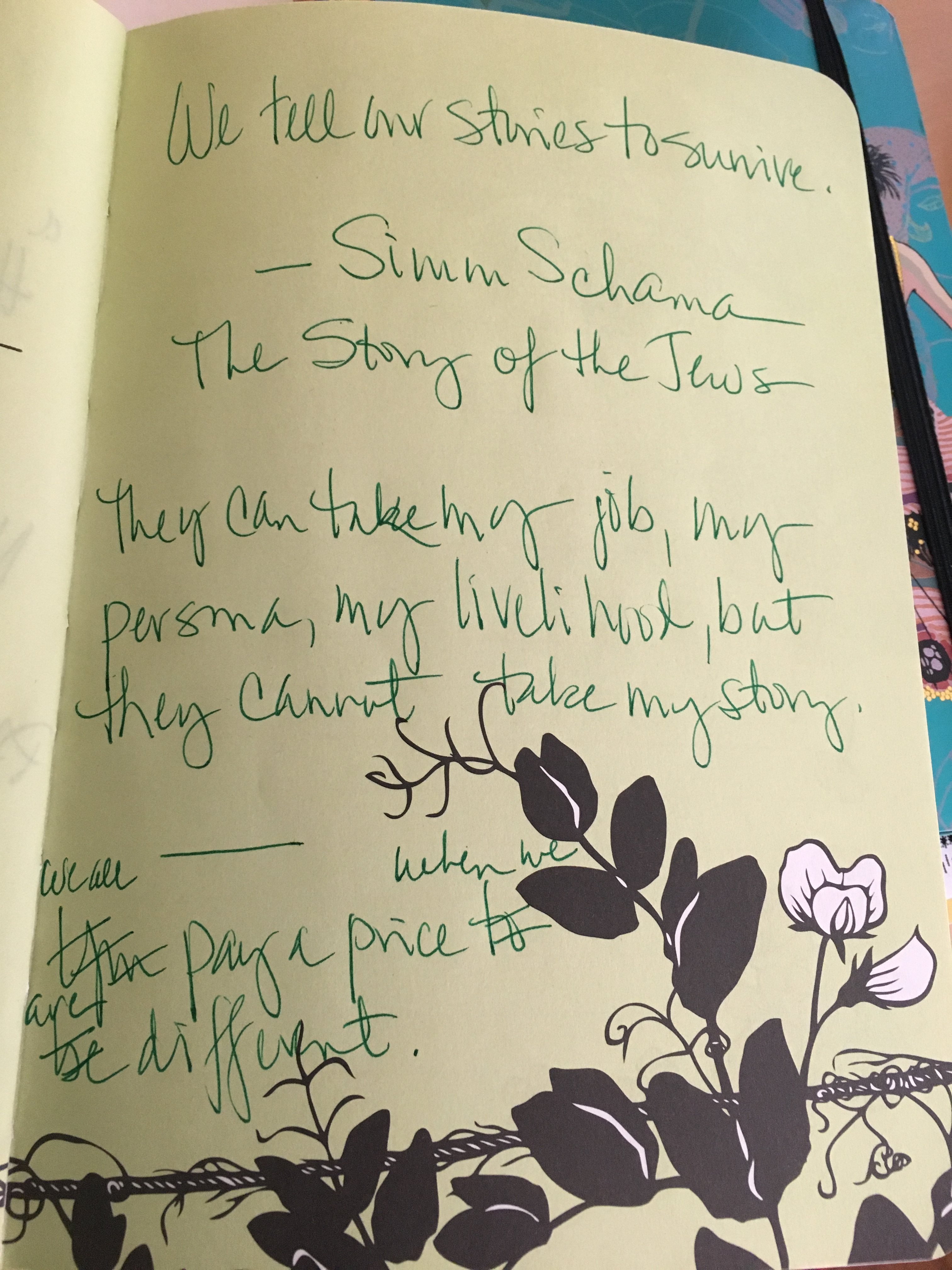
As Simon Schama said in The Story of the Jews, a five-part PBS documentary about the 3,000 year history of the Jewish people:

We tell our stories to survive.

Yes, we do tell our stories to survive and perhaps lay down the burden of carrying them alone. We tell our stories so we can communicate, connect, share wisdom, build community, touch others, and breathe hope into the idea that by sharing some of the worst indignities visited upon humans by other humans (genocide, child abuse and/or child sexual abuse, rape, murder, torture, racism, apartheid, slavery, and other degradations of the body, mind, and spirit) we will make it just a bit less likely that particular horror will happen again.

Here is my husband Kurt with our adorable 6-month-old grandson who we call Little Man because he is already such an amazing presence.

Personally I can only place one foot in front of another by turning my head from the many problems I can do nothing about and taking refuge in the everyday good I can do. As American author and illustrator E.L. (Elaine Lobl) Konigsburg (1930-2013) wrote:

Happiness is excitement that has found a settling down place. But there is always a little corner that keeps flapping around.

The highest joy we can imagine is living in the presence of our 6-month-old grandson who himself lives gloriously in every new moment of his strange new world. He loves to touch faces, feel water on his body in his shower/bath in my kitchen sink, and taste yogurt and other foods for the first time. Watching him discover the world opens my eyes to hope as he shares his new-eyes world with us and we share our how-things-work-around-here world with him.

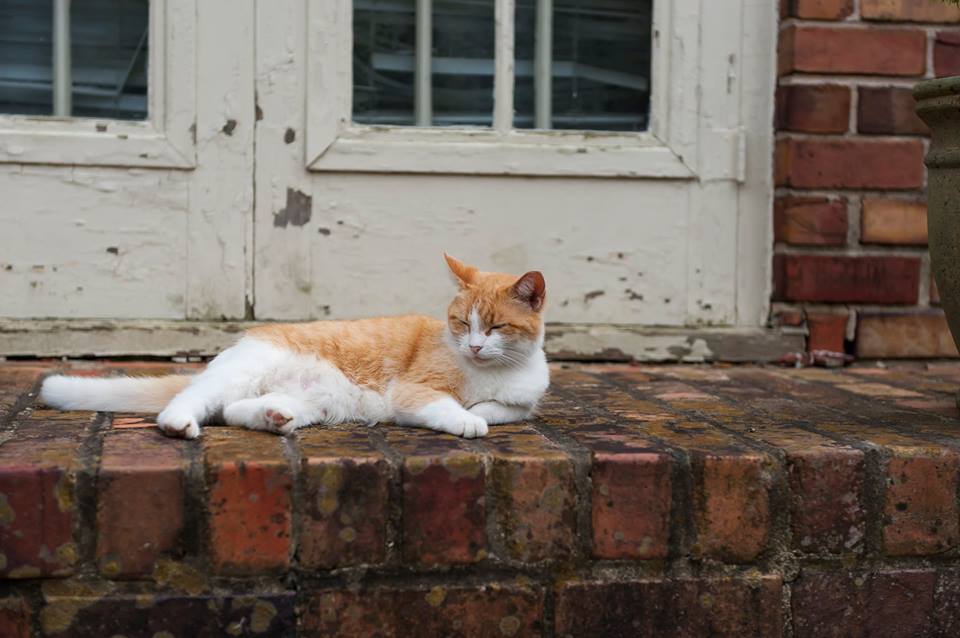
Nothing says cozy to me so much as a cat nestled into a sunny spot taking a nap. Yet with nine lives to burn, a cat can be off in a flash chasing a mouse or outrunning a barking dog. Something about ying and yang. Balance. Settling down and still flapping around. Happiness creeps up on us when we least expect it, and we can’t really expect it to stay ’round forever. So savor the little things for all they are worth–and open your arms to the joyous little things in this world that make life gloriously worth the living.

~ Anna – 4/30/2018


Posted in Autobiographical, Childhood, Courage, Ideas, Wonder | Tagged , , , , , , , , | 2 Comments

A Blue Moon Easter Eve

I haven’t written a blogpost since January because the last two months have been a blur of  packing, downsizing, moving, and all the details that such a nightmarish task entails. At times we have wondered if we should have left well enough alone and stayed in a neighborhood where we never quite fit in, but where there was room for all the stuff we have accumulated over the past 15 years.

Goodwill could power a whole store with all the items we donated to them on a daily basis throughout February and March. The friendly women who helped us with our boxes at the drop-off door probably decided we were crazy to have so much stuff and to be ever-so-willing to get rid of some much of it. Freedom is less stuff to drag around through life–or at least that’s my motto.

Despite the exhaustion from the devastating effort of this move, our new home in the Old North Knox neighborhood of Knoxville is indeed a neighborhood. We have already been welcomed by our a host of our neighbors in a way we never were in our former, more suburban, home in the West Knoxville area. Here we have sidewalks, a park nearly across the street from our house, and a market as well as a whole host of businesses and restaurants within easy walking distance. We finally feel we are home.

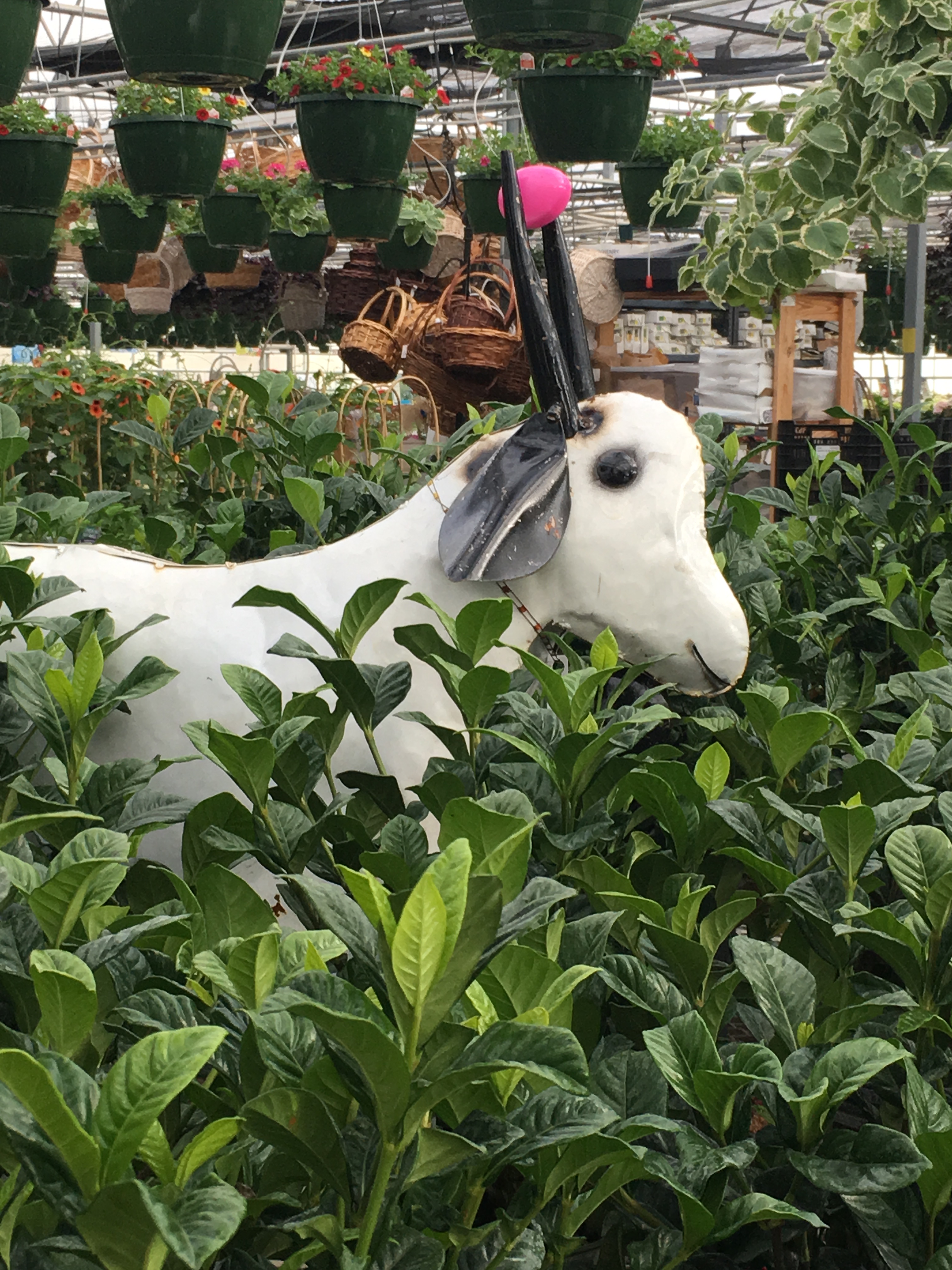
However, there is no time for a long post so late on Easter Eve, so tonight I send you, my loyal blog followers, a photo of the metal, garden art goat that found a new look for the annual Easter Egg Sale at Stanley’s Greenhouse today. This goat reminds us that once in a blue moon (and yes, I read in today’s paper that a blue moon was visible sometime today–and there will not be another one till 2020) magical things can happen on Easter Eve. Such as? Feeling at home, as well as finding a pink Easter egg inexplicably placed between your horns.

The metal garden art goat (ceremoniously and unceremoniously) decked out for the annual Easter Egg Sale today at Stanley’s Greenhouse.


// Anna ~ 3/31/2018


Posted in Autobiographical, Backyard Nature, Happiness, Home, Knoxville, Writing | Tagged , , , , , , , | Leave a comment

The Paper

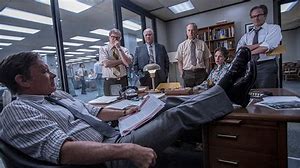
Steven Spielberg’s latest movie “The Post” tells the story of how Richard Nixon tried to stop the New York Times and the Washington Post from telling the American people their leaders doubted the outcome of the Vietnam War from its beginnings.

Until I watched Steven Spielberg’s latest movie “The Post” last evening, I had never thought of the throughline that newspapers have had in my life.

When I was growing up, Daddy supplemented our income by working Saturday nights–through the night until the compilation work was done–at the Knoxville News-Sentinel putting ad circulars into the rest of the paper by hand.

Being a sports maniac, Daddy thrilled at seeing the Sunday sports page–with all the notable sportswriters of the time–on Saturday night before the papers were delivered on Sunday.

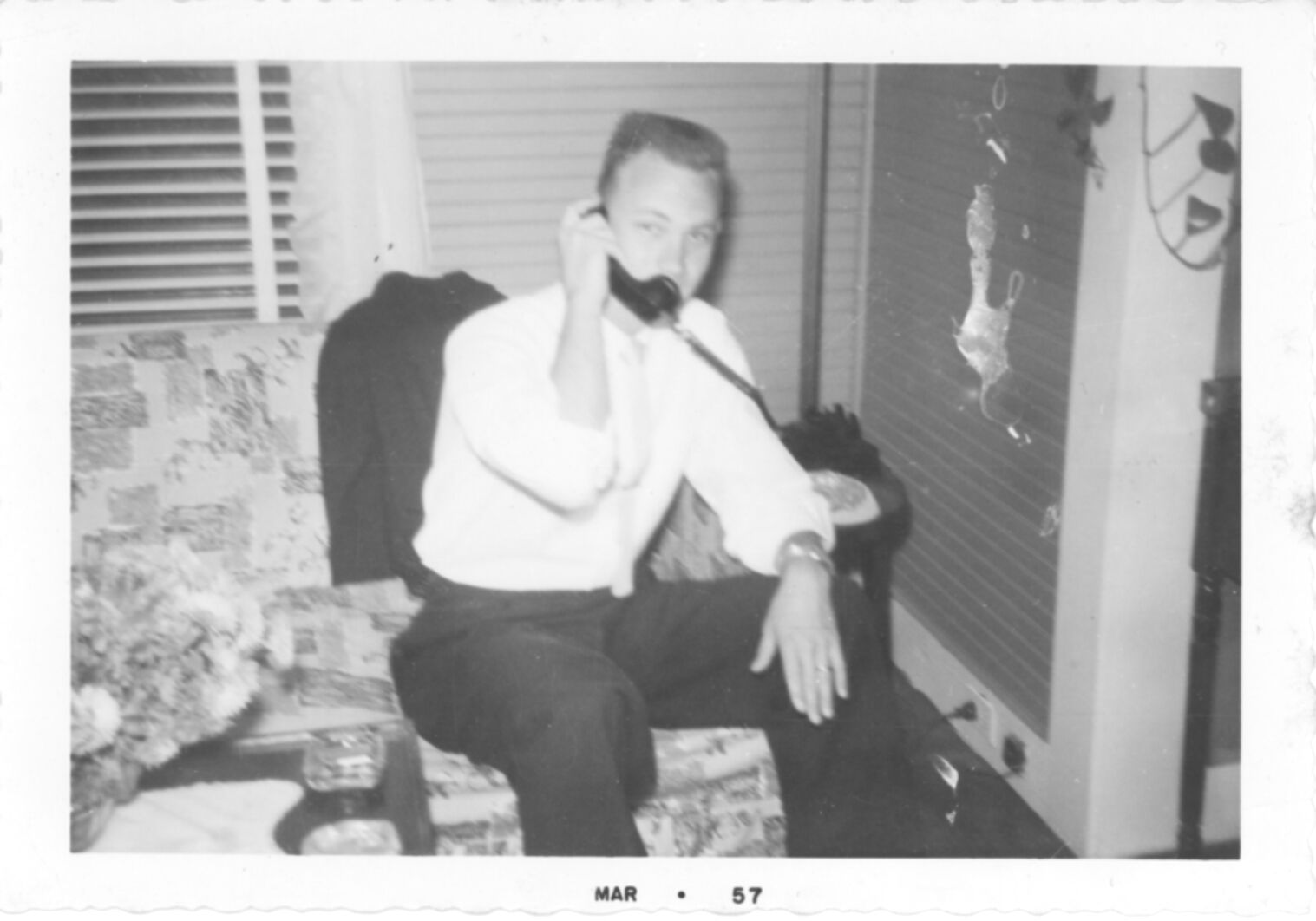
Daddy at my grandparents’ home in 1957.

When he was just out of high school, my son Justin started working at the News-Sentinel in distribution and worked there for 13 years–even after he began going to college.

He was a union representative during a difficult time at the paper when he and his fellow distribution employees worked without a contract. Such was the way of unions in the South: not as numerous or as powerful as those found in the North.

Lisa, a dear friend I grew up with, worked for the local Knoxville paper as a reporter. I envied her job because she wrote for a newspaper. The real deal. Putting words on paper, telling stories that were conveyed into people’s homes, changing opinions and lives.

Snow on the University of Tennessee campus in 1934.

After a few years at the paper, my friend switched jobs to work for the University of Tennessee’s liaison with papers across the state and nation, its Information Services office. I suppose working for a paper was not a good living wage for a woman starting out in the 1980s in Knoxville. And I’m quite sure it is the same now that the News Sentinel no longer has a hyphen in its name and is no longer a truly local paper either. It was subsumed a few years ago into the Gannett/USAToday corporate amalgam of papers that use USAToday stories and add in some local flavor, sports, and obituaries. The rates go up, and the papers get slimmer, and the Knoxville news too often doesn’t get told.

Knoxville lost its main alternative weekly newspaper twice. The highly popular Metro Pulse was purchased by the News-Sentinel organization, then canceled after a few years when Gannett bought the Sentinel. The subsequent upstart Knoxville Mercury newspaper, with editors and contributing writers from the Pulse, lasted a few years before it too bit the dust in a town that really could use some truly local reporting. My nephew’s amazing girl friend Paige wrote for the Metro Pulse, and my dear friend Stacey worked for the Mercury. I was devastated at the loss of both papers.

When you move in the Fort Sanders area of Knoxville, you can actually get carried away.
Photo: Knoxville Mercury

Without a local, independent paper, Knoxville is a small-town city without a voice. The stories covered by the Metro Pulse and then the Knoxville Mercury were the investigative stories that needed to be told to an audience that was eager to read it.

When our house in South Knoxville–that we had tried to sell for two years–needed to reach the attention of folks who might be interested in buying it, our real estate agent placed an ad in the Metro Pulse and sold our house in three weeks. Putting an ad in the News Sentinel would not have the same effect now–nor would it have 15 years ago.

As I watched “The Post” and saw its depiction of the craftsmen working with blocks of type to ink the paper, and the long line of newspapers flowing high above the pressroom, it reminded me of what my Daddy used to say about loving to see the presses run. The thrill of watching blocks of type, combine with ink and paper, get folded in half, and sent out “hot off the presses” containing the hopes and dreams and stories of the people of our city.

A 1956 bride photographed with her father–my mother and my grandfather.

And what stories: who died, who won the football game on Saturday, who was getting married, who had gotten a scholarship, the scandal when one of Tennessee’s governor went down in shame, the glory of all the University of Tennessee’s Lady Vol national championships. It was in the paper and we shared a community of information that is for the most part gone.

Sure the News Sentinel still has a sports page with local writers, that’s one of the few sections of the paper that actually still has a stable of writers. Because sports is, after all, what this town is really interested in. But we used to have more than that. Of course, the News Sentinel was never a muckraking paper and did not win many national awards. But it was our paper. And told our story.

General Eisenhower with President Franklin Delano Roosevelt during World War II.

Many people do not care about the downturn in the fortunes of daily newspapers because, well there is, after all, the Internet and broadcast television news. But thank heaven for the few papers who pay reporters to write the stories that hold the rich and powerful accountable because that is what is critical to the health of a democracy.

Even though we don’t really have a democracy, since twice in the past 20 years the choice of the majority of voters did not become President of our country. But at least we ascribe to democratic values, we defend democratic values at home and abroad, and we tell ourselves that we act on democratic principles–that the will of the people means something in this country.

In order for the will of the people to mean something, however, a free and independent press must hold the government (at all levels), corporations, businesses, banks, the rich, our politicians, and our leaders accountable. Because that is what our nation was based on, and that is what keeps us free in any real sense.

So, yes, I would have been proud to have worked for a newspaper and been one of those few women who rarely made it to the table where decisions were made, but were at least on the team of a real newspaper. I would have been honored to tell the stories of people from all walks of life.

Author Dorothy Allison’s autobiography Bastard Out of South Carolina was one of the books I read that really spoke to me as a writer, and as a child who grew up poor. I was lucky enough to meet her when she came to the University of Tennessee to talk to would-be writers in the university’s English department. She told us, “Tell your stories. That’s your gold. We want to hear your stories.”

She was right. And we must continue to tell our stories. We must find a way to tell our stories, even though the traditional ways to be heard have dwindled, and it is harder to hear and learn each other’s stories.

I suppose this blog is my attempt to continue telling my story. And my Daddy’s. Although he is gone, he is with me as long as I live–and for me he is still smiling at the wonder of it all: those papers on their conveyor belts, speeding on their way to all those homes where people will read them and together they will weave their common language of community and hope.

//Anna ~ 1/31/2018


Posted in Autobiographical, Courage, Knoxville, Op/Ed Thoughts, Screen, Women, Wonder, Work, Writing | Tagged , , , , , , , , , , , , | Leave a comment

Ode to Little Man

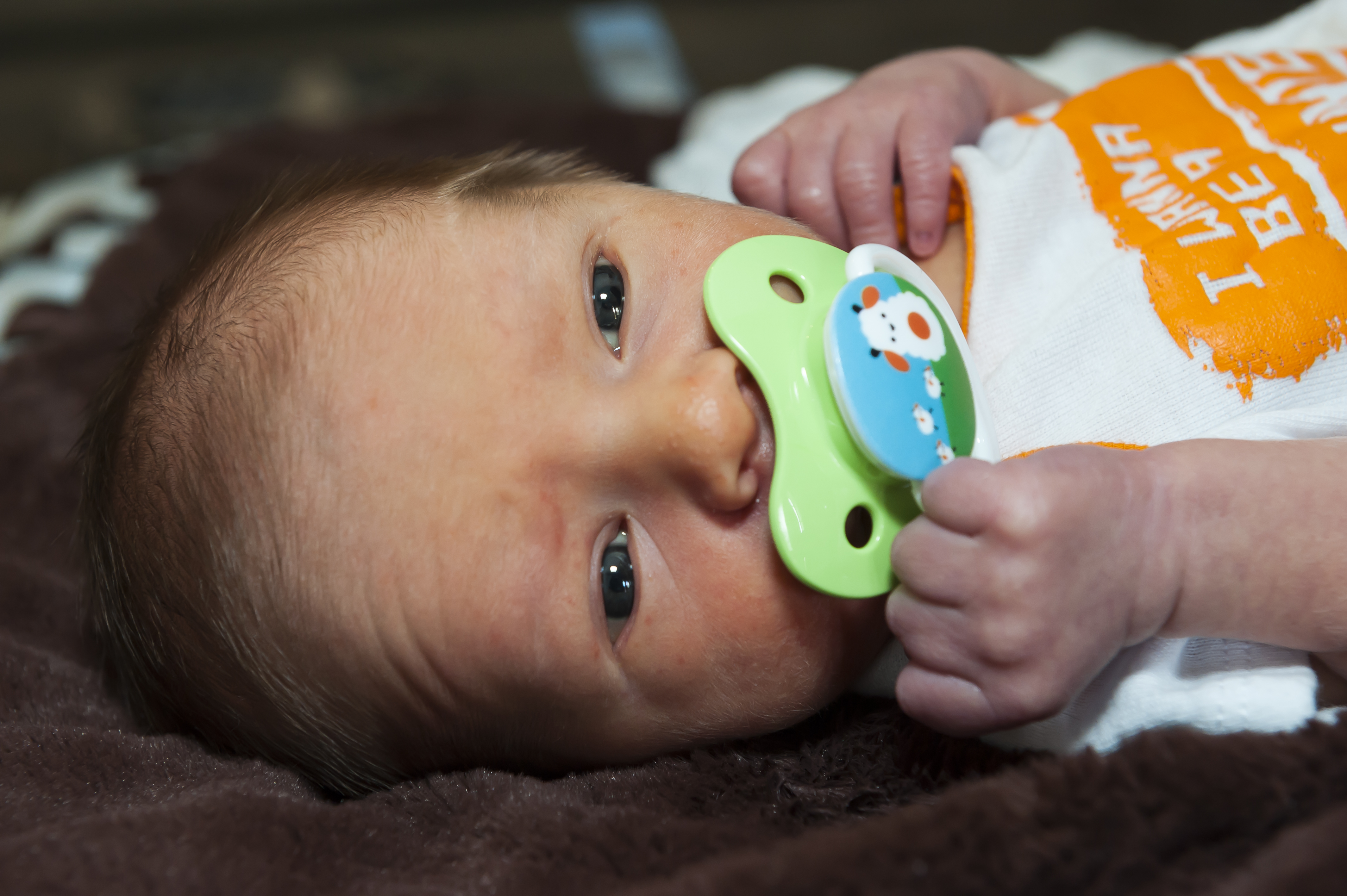
Lincoln, our 1-month-old Little Man.

I have a dark-eyed, adorable obsession: the Little Man who a month ago was born into our lives. Last year my son Justin married the love of his life Tracy. From their love, has come their son Lincoln, the already dignified and compelling presence we call Little Man because he is already so much his own person! And he was born with such large hands that he is still growing into them.

When I was a child, I used to swing on my grandparents’ backyard swing set and make up songs. I can’t remember a time that music has not played in my head when I am not dealing with all that life stuff that keeps me running about. So over the past few weeks I have made a lullaby for Little Man to the tune of the song Little Bird, Little Bird, written by Mitch Leigh in 1972 for the Broadway musical Man of La Mancha. So here we go . . .

Little Man, Little Man
Don’t you wanna wake up?
Little Man, Little Man
We can have lots-a fun!

You can stare at me
With your big dark eyes
I can coo at you
Try to make you smile

Open up your arms
To the big wide world
Who’s more lucky
Than us!

Lincoln on the day of his birth.

The unadulterated force of my love for Lincoln and joy at his birth has been in sharp contrast to rest of the past year. Since I lost my dear father a year ago, and we gained an untenable leader for our country, I have been despondent about the present and the future.

I was born in the United States–in Tennessee, a historically poverty-stricken state, I’ll grant you–at a time when the country was riding high. When I was old enough to be aware of the world around me, America was about 25 years past saving the world from Nazism; World War II veterans were in their prime and led local, state, and national organizations; and we were proud of our place in the world.

Our high school chorus sang:

Give me your tired, your poor,
Your huddled masses yearning to breathe free,
The wretched refuse of your teeming shore.
Send these, the homeless, tempest-tost to me,
I lift my lamp beside the golden door!

Little Man, a few weeks old, with his big hands.

Until today when I looked up the exact wording of this song, I did not realize the lyrics of this song were written in 1883 by Emma Lazarus, a New York poet who was the daughter of Jewish immigrants. She wrote it to help raise money to properly exhibit the Statue of Liberty which was given to our country by France. This statue, formally called The Statue of Liberty Enlightening the World, was given by the French people out of friendship and to mark our countries’ shared commitment to democratic ideals.

When we received this extravagant gift, many Americans were less than thrilled about a monumental statue of a woman holding a torch which required an expensive pedestal in order to display it. Fundraising efforts were not going very well, so its leader asked Emma Lazarus, a 34-year-old New York poet, to write a poem to be auctioned–along with works by other popular artists of the time, such as Mark Twain and Walt Whitman–to secure enough money to exhibit Lady Liberty in a fitting manner.

Although she was reluctant to write a poem on demand, Lazarus contributed a sonnet to the effort. As for Mark Twain, he refused to contribute any of his work. Instead he sent a check with a letter enclosed proposing that a statue of the Biblical Adam would be more fitting and wrote:

What do we care for a statue of liberty when we’ve got the thing itself in its wildest sublimity? What you want of a monument is to keep you in mind of something you haven’t got—something you’ve lost. Very well; we haven’t lost liberty; we’ve lost Adam.

Another thing: What has liberty done for us? Nothing in particular that I know of. What have we done for her? Everything. We’ve given her a home, and a good home, too. . .

But suppose your statue represented her old, bent, clothed in rags, downcast, shame-faced, with the insults and humiliation of 6,000 years, imploring a crust and an hour’s rest for God’s sake at our back door?—come, now you’re shouting! That’s the aspect of her which we need to be reminded of, lest we forget it.

When I read Twain’s objections to the Statue of Liberty, it was not clear to me what aspect of Adam, the Biblical first man, Twain believed Americans had forgotten and needed to remember. According to Genesis, Adam and Eve lost their freedom to decide their own fate by disobeying God and were cast from their home, the Garden of Eden.

Perhaps Twain meant that a statue of Adam would be an apt reminder that we should safeguard our freedoms better than the first man reputed to have lost his. Although Lady Liberty has been a very effective inspiration to the world fpr the past century and a half, Twain’s admonition could be more relevant to our present-day situation than his own.

In any event, Twains’ alternative suggestion went unheeded, and Emma Lazarus’s sonnet, The New Colossus, was read at the Statue of Liberty’s 1883 exhibition.

Not like the brazen giant of Greek fame,
With conquering limbs astride from land to land;
Here at our sea-washed, sunset gates shall stand
A mighty woman with a torch, whose flame
Is the imprisoned lightning, and her name
MOTHER OF EXILES. From her beacon-hand
Glows world-wide welcome; her mild eyes command
The air-bridged harbor that twin cities frame.

‘Keep, ancient lands, your storied pomp!’ cries she
With silent lips. ‘Give me your tired, your poor,
Your huddled masses yearning to breathe free,
The wretched refuse of your teeming shore.
Send these, the homeless, tempest-tost to me,
I lift my lamp beside the golden door!’

The love of our lives.

Lady Liberty has welcomed millions of refugees to America which has been a sanctuary from oppression, a land of opportunity and second chances. Her welcome presence in the New York harbor has been a symbol to hope to  immigrants seeking a better life.

Like Lady Liberty, my grandson’s birth awakened a hope in me that I thought was gone. When I look into his eyes, I want to ensure he has a world where he can breathe freely, love who he wants, do what he wants, and realize his dreams. Despite the daily evidence to the contrary, Lincoln’s existence gives me hope.

Loving Little Man as I do makes me want to fight for his best future. It is no coincidence that a female figure was chosen to exemplify the ideals of democracy and freedom, even if females have not always been able to exercise those rights in this country. Now that women have the right to vote, we should use that right from an impulse of love, not an impulse borne from (and born out of) fear and hate. More than with our vote, we should also use our individual talents as well as our combined efforts to conserve and protect our environment; provide affordable health insurance for all, but especially for children; promote policies that favor the majority of people, not policies that favor only the wealthy and powerful; and support regulation and legislation to make education at every level more child-friendly and affordable without graduate-school education benefits being taxed as compensation.

I am not a glassy-eyed Pollyanna, but a realist who knows the odds are stacked heavily against us. But we must do what we can. Twice in the past two decades, our country has demonstrated that Americans do not, by definition, live in a democracy where the power of the people and the rule of the majority decide their leader. We can argue about many things, but the present rule by the minority over the will of the majority is our present-day reality. However, I am encouraged by the fact that America and her allies overcame the Nazis in World War II and put an end to the systematic death machine of the Holocaust. If we could overcome the seemingly unbeatable German juggernaut, perhaps we have a future beyond the chaos of our current governance.

May he have the chance for a bright future.

A few years after Emma Lazarus wrote her poem to help raise money for the Statue of Liberty, she died of cancer at the age of 38. Her obituary did not mention her contribution to the way the world viewed our country: as a symbol of hope and liberty. Although it wasn’t till 1903 that her poem was championed and her words were added to the Statue of Liberty, her work has inspired generations to emigrate to theis country that my grandson’s namesake, Abraham Lincoln, said was “conceived in liberty and dedicated to the proposition that all men are created equal”.

Sometimes the best efforts can seem lost for years, but then they may unexpectedly resurface above the waves, and find safe harbor. May it be so–sooner rather than later–for the precious sweetheart we call Little Man, and all the other little women and men we hope will have a future in this world.

// Anna ~ 12/1/2017


Posted in Autobiographical, Childhood, Courage, Freedom, Happiness, Ideas, Love | Tagged , , , , , , , , , , , , , , , , , , | Leave a comment

Daddy’s Ro-phorisms

My sister Lisa and me in the snow outside our first home, 1963

When I was growing up Daddy used to drive me crazy with his corny aphorisms for every situation.

We didn’t have the money to eat at the fancier restaurants such as Shoney’s–yes, we were indeed that poor. Mama and Daddy would occasionally take us through the McDonald’s drive-through where the odds of getting a plain hamburger for finicky me were pretty slim. About half the time my “plain” hamburger came with the icky mustard and ketchup abomination they slathered on those unsuspecting burgers!

Mama would say, “Wipe it off with your napkin.” And Daddy would chime in with, “Anna, you’ve got to take the sour with the sweet.” I didn’t want to take the sour with the sweet! I  wanted a plain hamburger on a plain bun without the nauseating condiments that made me want to throw up.

But making do was my family’s mantra. Don’t make waves. Don’t ask questions.

Doctors always knew best–even if we went to the quack doctor in our poor side of town who diagnosed my torn cartilage as water on the knee. I walked around on that swollen knee for months before the former nurse across the street said, “You’d better get that looked at by a knee specialist I know.” The orthopedic doc suggested surgery right away. Voila! I could walk.

My mantra was making it better. Whatever “it” was, I wanted to read about it, learn about it, ask questions about it, organize it, devise a better system for it, put a bow on it, and for sure not have disgusting condiments all over it. Let’s say my parents and I were not always the most smooth dance partners for a childhood pas de trois.

Our second home with the big old trees in the front yard that Daddy hated because he hated raking leaves.

Daddy however was one to rail against the elements. With grim resolve, he’d say, “I’ve gotta go down and stoke the furnace.” From the pile of coal in our backyard, he’d take a goodly amount of coal in a bucket down to the furnace in our dirt-walled basement. If he was successful, the registers that brought heat into our house would spew forth warmth. If he was not successful, we were cold.

I’ve often said it, Daddy would have made a good king. He would have been a magnanimous monarch of a well-off country if there was a tidy bureaucracy to look out for all the details of his duchy. Justice and integrity would have ruled the day. But Daddy was not mechanical, he certainly could not fix anything, and he was so methodical with everything he attempted that he was left in the dust by the cut-corners, beer-and-pizza, salt-of-the earth men of his time and place.

But Daddy had his values, his aphorisms, his theories, and his truths. Some of them were spot on, some less so. I find now I trot out more than a few of Daddy’s sayings to put the punctuation mark on life’s ups and downs.

We’ll cross that bridge when we come to it.

Jealousy. It’s jealousy. That’s the root of all evil.

This is dogwood winter, next we’ll have blackberry winter, and then whippoorwill winter.

An apple a day keeps the doctor away.

Better late than never.

Beggars can’t be choosers.

You win some, you lose some.

You can’t beat a good team twice.

You can’t take it with you.

We don’t want to wear out our welcome.

Give them an inch, they’ll take a mile.

Live and learn.

Dad-jimmit!

Dad-gummit!

Time flies.

It’s as slow as Christmas.

That’s a pig in a poke.

You can’t have your cake and eat it too.

Money isn’t everything.

Little things mean a lot.

Two wrongs don’t make a right.

Practice makes perfect.

Two heads are better than one.

That’s the pot calling the kettle black.

Where there’s a will, there’s a way.

Don’t go out with your head wet.

Get home before dark.

Did we turn the stove off?

Daddy being irrepressibly himself at a 1996 wedding reception.

Daddy was especially fond of asking about the stove being off–a sign of his obsessive-compulsive disorder, along with his taking an hour to shave. We used to have a hee-haw, my sister and me, shaking our heads about Daddy taking an hour to shave. Bless his soul. I miss him so.

My Daddy, Roy Rotha Allen, died a year ago on December 2, 2016. I think of him often. My husband Kurt and I enjoy quoting Daddy’s sayings to each other. I usually preface one of these wisdoms with “as Daddy used to say . . . ” Kurt calls them Daddy’s aphorisms, his Rotha-isms, or his Rophorisms.

Despite Daddy’s 10th-grade education, his mother dying when he was only 4 months old, and his being raised in a home full of neglect, alcoholism, and abuse, Daddy was the parent who taught me to laugh and live life with open-armed passion and joy. He taught me not to be afraid of living life to the fullest, to talk openly, to question, and to love without reserve. He taught me these things because I shared more than a bit of his genetic makeup, and I watched him live. He loved me without qualification and without trying to make renovations, as Mama tended to. He was proud of me and everything I accomplished. He was proud of my education and the jobs I earned that allowed me to make a difference in the world.

Daddy at Christmas 2000.

Mama gave me my energy, drive, and hardworking, never-say-die work ethic. But Daddy gave me the sweet love that sustained my soul during the times in life when I was in serious harm’s way. He LOVED me. And because he loved me, I knew in my bones how to love others. Loving myself and accepting myself with all my imperfections has been hard; I am my own worst critic. But Daddy saw only my shiny-faced good points, and he made me glad to be alive.

He still does. And as long as I live, he will always be with me. He is still my sweet, sweet, adorable, dearest Daddy.

//Anna ~ 11/30/2017

Posted in Autobiographical, Childhood, Courage, Family, Happiness, Home, Joy (Joie de General), Love, Writing | Tagged , , , | 2 Comments

Arriving at Last

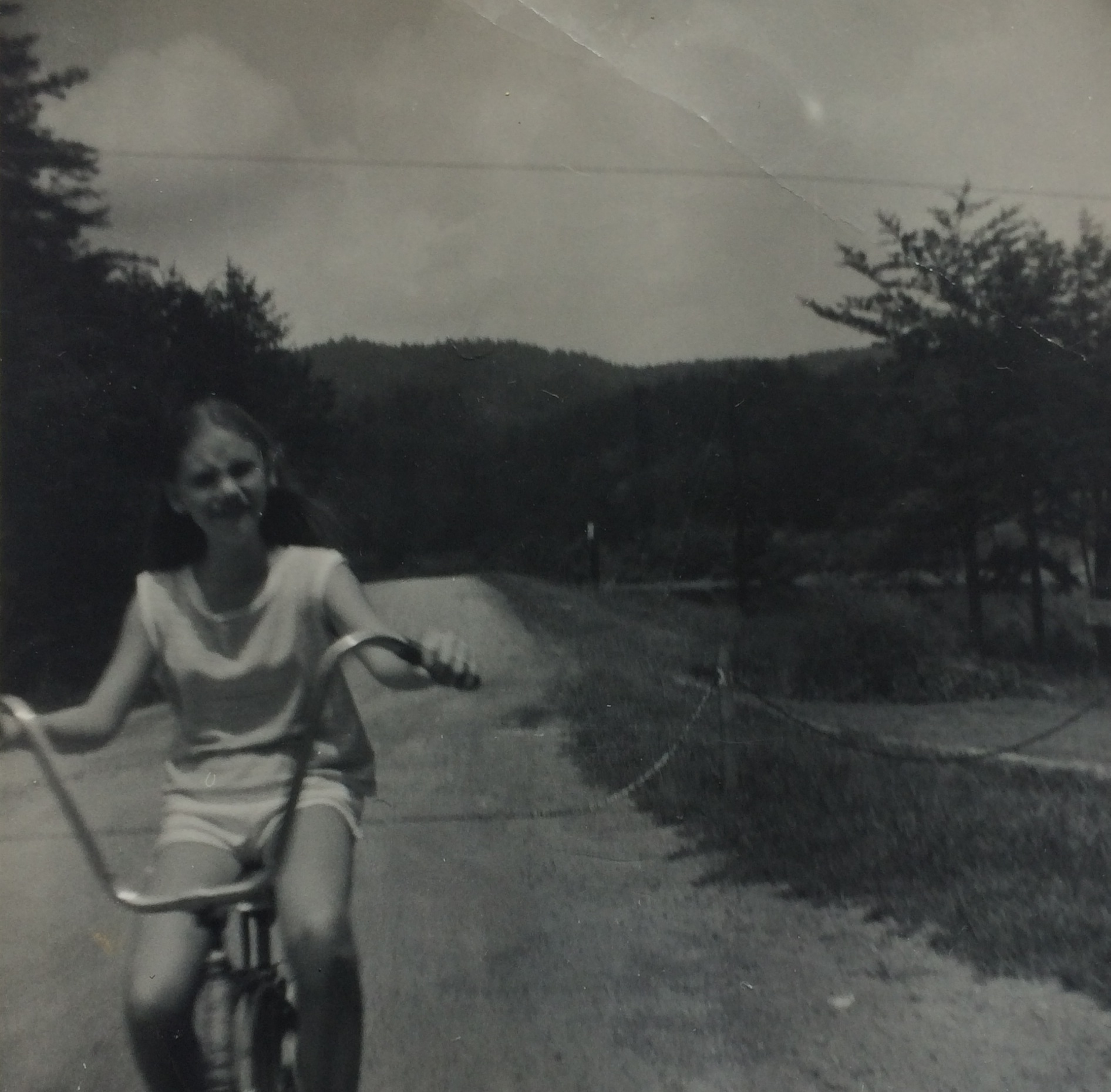
The young dreamer, circa 1972.

In the fall of my senior year at South (Knoxville) High School, I was offered a full scholarship to Berea College, a small liberal arts college in Kentucky.

I didn’t know it at the time, but Berea was founded in 1855 by abolitionists who took their beliefs seriously enough to start the first interracial and coeducational college in the antebellum South. They expanded their mission through the years to offer poor Appalachian kids like me a free college education in exchange for working at the college.

Although my father was proud of my academic accomplishments in school, he made it clear he could not help me with my college education. He was not being unkind, just stating the obvious, since my family’s income was around $7000 in 1975. I knew I needed scholarships to attend school and was especially excited about a full scholarship to Berea where everyone would be a kid of limited-to-no means like me. Coming from a family where Daddy’s father was illiterate and Daddy did not graduate from high school, I was the first person in my family to seek a college education.

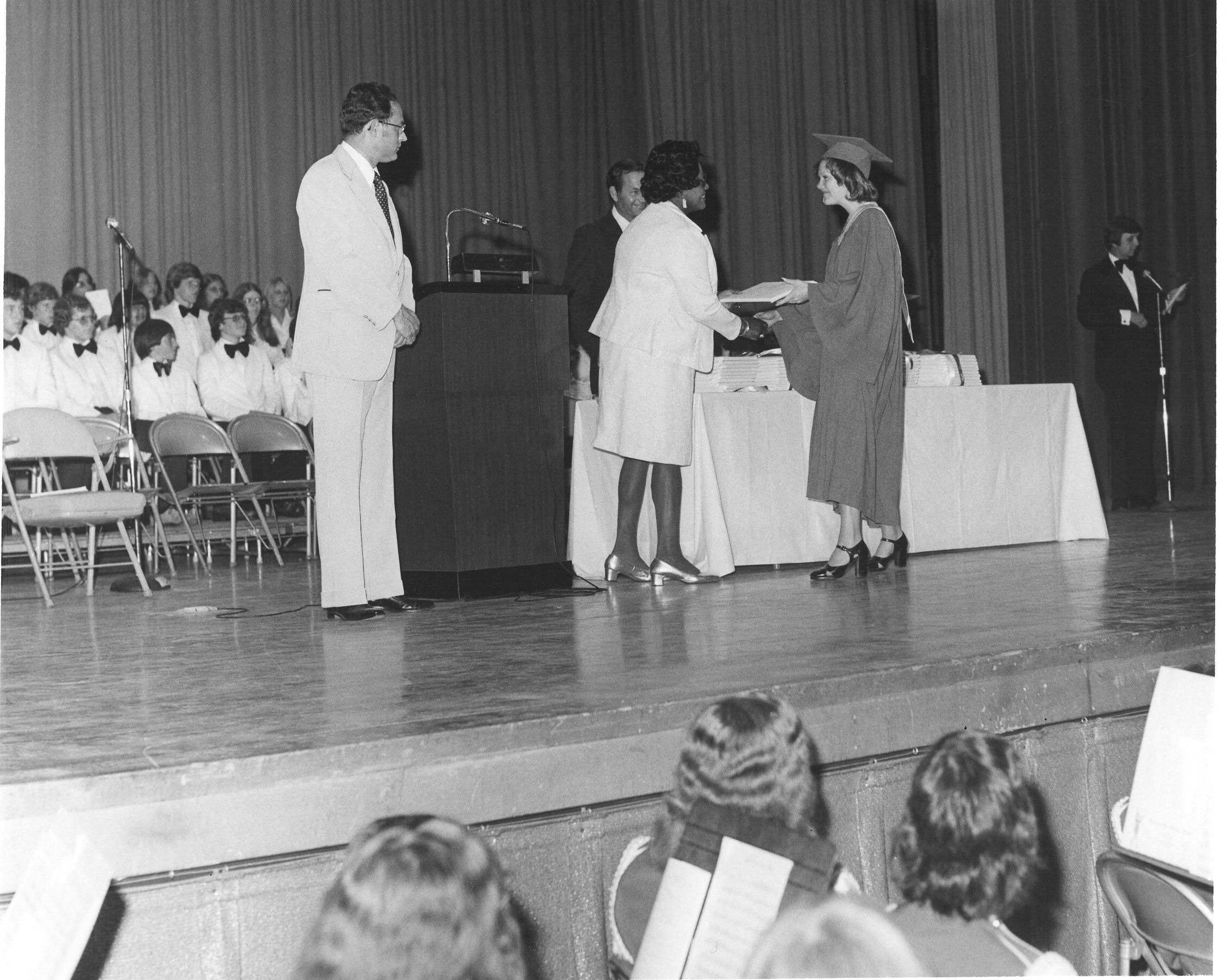
Accepting my diploma from high school in May 1975.

Making this whole Kentucky college education dream even more appealing to a naive, hopelessly romantic girl–who had grown up on a steady diet of old-time movie romance–I had met a young man from Kentucky that past summer. His father, the pastor of the Prestonsburg Baptist church, was a close friends of the pastor of our church in Knoxville. In the mid-1970s, Prestonsburg was a small town in Floyd County with one red light–a milestone over which there was great excitement and pride. There was even talk of a second one coming soon.

Our church youth group was invited to Prestonsburg to hold Vacation Bible School classes for the kids of coal-mining families. Just down the road from town, the hollers of nearby Johnson County hadn’t changed much since Loretta Lynn–the world-famous, country music singer-songwriter–grew up there in Van Lear, Ky., 30 years before.

The young preacher’s son, Dell, was kind, attentive, also a rising senior in school, and was such a gentleman when we went to see a movie at the nearest theater in Paintsville. The West Virginia line was just 30 miles or so away. This was coal country where mining families lived in hollers (hollows) that went straight up the mountainsides. I was amazed that their front yards were mud, the houses where not much more than shacks, but there were usually several cars beside them–some on cinderblocks, but some quite pricey. What little money they had went toward wheels, either for bragging rights or perhaps to take you someplace you’d rather be.

Here I am in April 1975, just before I started college in June.

My Kentucky gentleman and I wrote each other when I went back home to Tennessee for my senior year. My parents even took me and my sister up to see him play quarterback in a football game that fall. He had been voted Mr. Prestonsburg High, was the quarterback of the football team, and was a Baptist preacher’s son–what more could a young Southern, religious, girl like me want?

I dated no one my senior year, didn’t go to my senior prom–not that it was a terrible hardship since I hadn’t gone to many dances during my years at South. Being considered a “brain” had made me dateless for most of my high school years anyway. Instead I wrote earnest letters and dreamed of a future with such a nice guy as Dell. I must have confided to one of the girls at church about my dreams of going to college in Kentucky and a future with Dell, because she told a friend of hers in Prestonsburg, who mentioned it to Dell, and I received a Dear Jane letter. Perhaps a long-distance relationship was too tenuous to build a future on–or maybe he found someone else.

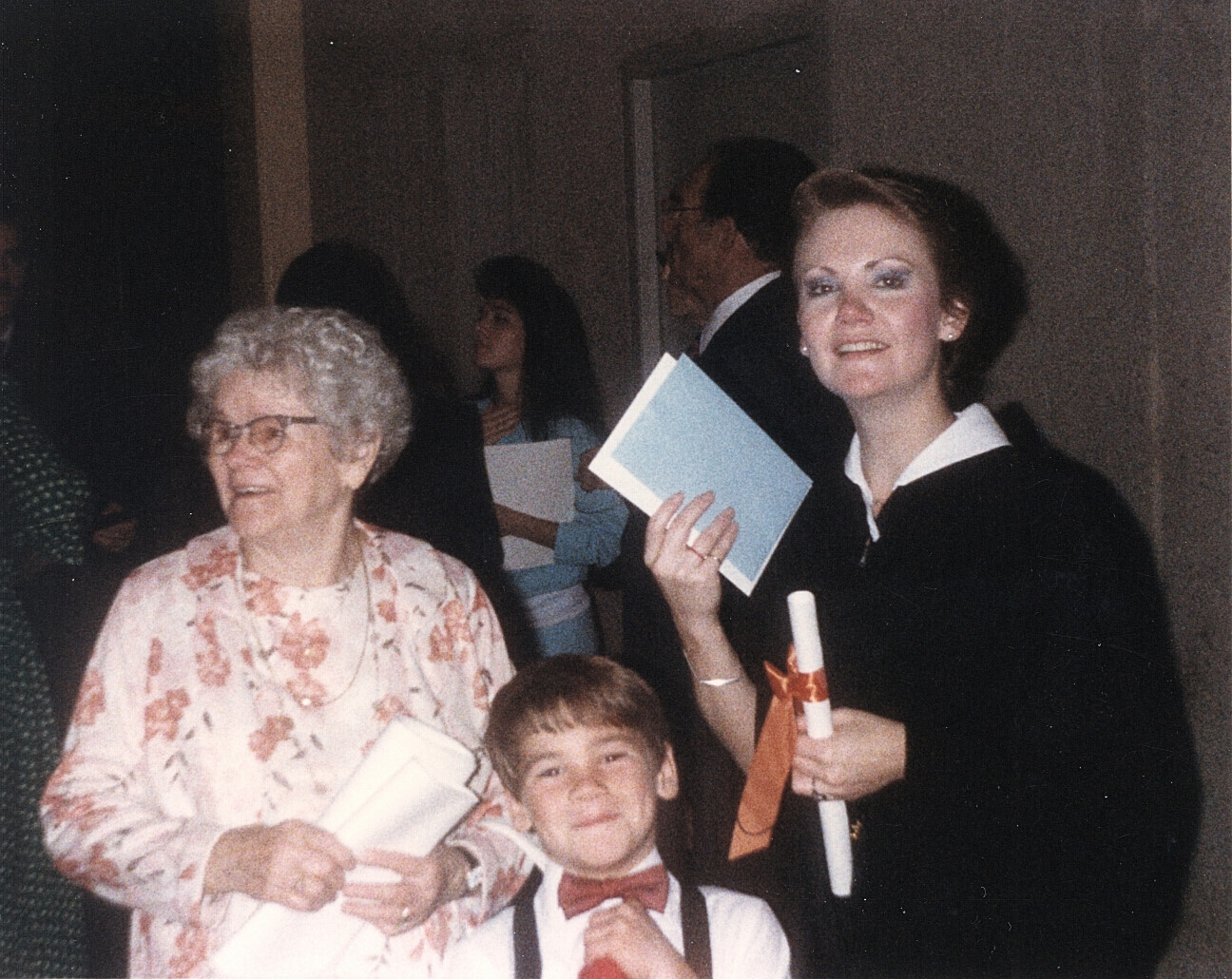
My Irish Mamaw Jerushia Cunningham Henderlight at my college graduation in 1987.

The breakup with my Kentucky boy friend made attending Berea College seem more like a pipe dream. So when I won a one-year Knoxville PTSA scholarship in an essay-writing contest, I decided to attend the University of Tennessee in my hometown.

Meanwhile life has happened over the last four decades. Busy, busy, busy. I graduated from UT where I worked for 30 years, the majority of those years spent writing for the fund-raising arm of the university. Education had been my ticket to a better life for me and my children, and I felt so fortunate to have earned a spot on the team that was working to ensure that other kid’s educational dreams could come true.

At the university I met an extraordinary man, Kurt, and we married in 1995. Ironically he had earned his undergraduate degree at Transylvania University, a liberal arts college in Lexington, Ky. This year our nephew Zach began work on his master’s degree at the University of Kentucky in Lexington, so last month the planets aligned and we gleefully set out to visit Zach and his adorable girl friend Paige at their home there.

Inside one of the gorgeously appointed buildings at Berea College. Photo: Kurt Weiss

Only a short drive from Lexington was Berea, the college that had offered me a full scholarship beginning the fall of 1975. I could have gone there, worked alongside other poor kids like me, and gotten a first-class education without debt or tuition. Of course, being such a sensitive, homesick kinda girl as I was at 17, I would have needed the additional incentive and support of a boy friend down the road at Eastern Kentucky University who was in the engineering program–which at the time was what Dell said he wanted to do.

But just for a moment, it is sweet to imagine that I had been raised by parents who knew more about the ropes of higher education, and I had been able to chart my own course at Berea. I could have become a history teacher or an English teacher, and gone on to make seemingly dry subjects shine, inspiring a few of my students to dream they could be more than the lives they were born into.

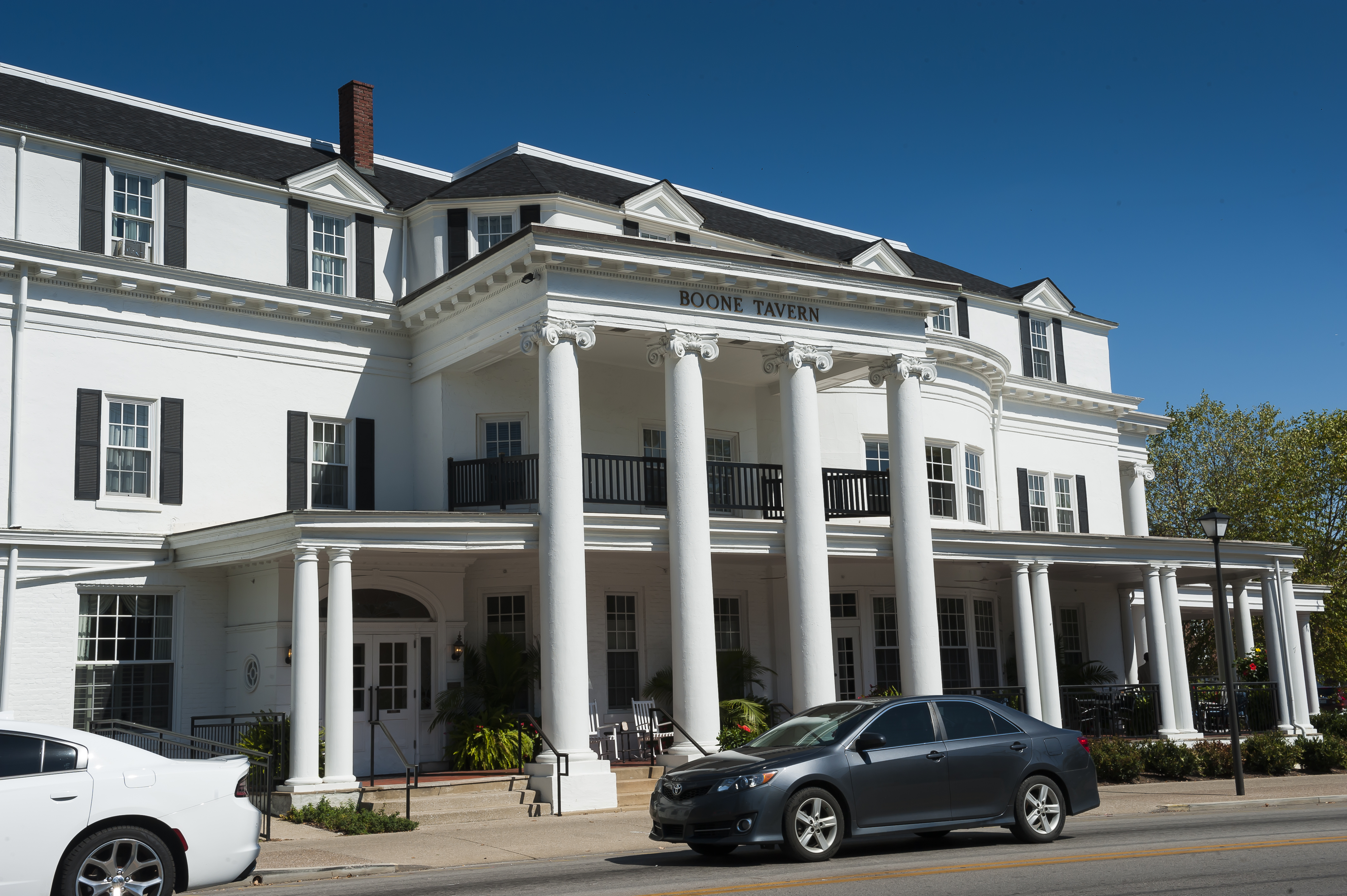
The Historic Boone Tavern at Berea College, September 2017, photo by Kurt Weiss.
It did not happen that way for me. But last month, in September 2017, Kurt and I left Lexington, went to Berea, and stayed at the college’s historic Boone Tavern, We had a tour of the campus given by an undergraduate student  who loves the school so much that she hates to leave even for holiday visits with her family! We enjoyed lunch in the student-staffed coffee shop, bought student-crafted mugs in the student-ran bookstore, and scored an organic rosemary plant from the student-ran farms of Berea. The grounds were perfect, the buildings immaculate, and everyone seemed very happy to be there.

One of only seven work-colleges in the country, Berea gives their students the highest quality education (worth approximately $100,000) and is consistently ranked one of the best private liberal arts colleges in the country. Pretty remarkable for a college that started with the dream of promoting equality by making education available to men and women of all races. Yes, men and women of all races.
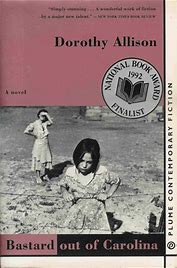

Love this tree that fits me perfectly! Photo: Kurt Weiss

There is more than one way to make a dream come true, and the road to fulfilling Berea’s full egalitarian, interracial mandate was littered with roadblocks–such as Kentucky’s law in 1904 forbidding the co-education of blacks and whites. But 46 years later, in 1950, Kentucky amended the law to allow co-education above the high school level, and Berea again accepted black students.

Soooo, I was not able to go to Berea in 1975, but 42 years later I arrived–a bit late for sure. But so excited to see the college for myself at last. The huge old trees dotting the campus were planted by students we were told, some of the buildings were built by students, and we watched as students mowed the college grounds. Talk about sweat equity. This is triumph of the spirit. Of course, not everyone who begins as a freshman makes it to graduation at Berea. Some students cannot keep up with the rigorous academic standards and work responsibilities. But for those who have the work ethic, determination, and heart, Berea is the train they can take to where they want to go which gives them more power over their lives. For that is what education does–gives you more power over your life.

I finally arrived at Berea College–a bit late, but so happy nonetheless!

Berea College was never able to make my dreams come true, but as an adult–with some occasionally disposable income–I can support Berea and help other ambitious young people of limited means to realize their hopes for a better life.

As the famous primatologist and conservationist Jane Goodall recently said in an interview printed in the October 21, 2017, edition of The New York Times:


I meet so many incredible people doing amazing things, saving animals on the brink of extinction, restoring the forest, cleaning up a river. It’s knowing what can be done that gives people the courage to fight.

Here’s to having the courage to fight and make a difference! And here’s to finally arriving!

Anna// ~ 10/31/2017

Posted in Autobiographical, Childhood, Courage, Education, Family, Freedom, Ideas, Writing | Tagged , , , , , , , , , , , | 2 Comments

Taking Along Our Ghosts

When I was young, I saw the 1979 movie “Being There” starring Peter Sellers in his most provocative role as Chance, a simple, uneducated man who grew up and tended the garden on a great estate, and had never been off its grounds. Since the film was shot at the gorgeous Biltmore House in North Carolina, I felt a special kinship to the movie since I had been there a few years before.

As the movie opens, Chance the gardener’s life has irrevokably changed with the death of the estate owner who was his guardian. Chance cannot continue his existence of simply tending the garden and must make his way in a world he does not understand. Curiously, however, everyone he meets “writes” onto Chance as if he is a blank slate seeing in him what they want to see. A misunderstanding of his name leads to him becoming known as Chauncey Gardner who inadvertently achieves fame by appearing on television as a man of simple wisdom who eventually becomes the chief adviser to the President of the United States.

Peter Sellers as Chance the gardener in the 1979 movie “Being There”.

Gardening is all he knows, and gardening is all he really talks about. Yet everyone he meets and the people who watch him on TV, see great imagery, depth, and import in his simple phrases about roots, growth, the seasons, and “liking to watch” TV.

I couldn’t help but muse about “Being There” and Chauncey Gardner after the night I woke up at 4:00 a.m., on November 9, 2016. The day before had been Election Day and I had followed the returns with mounting dread. At about 1:30, I went to sleep hoping against hope that my country would not elect a reality TV star as President. A scant few hours later I was awakened as blood poured down my throat from a burst blood vessel in my nose.

And it wouldn’t stop bleeding. As I held a wet Kleenex to my face, I texted my friend who (thank heaven!) is a wonderful ear, nose, and throat specialist here in Knoxville. I explained my situation and asked if she could work me into her morning schedule. Of course there was no immediate answer at 4:30 a.m., but finally the nose stopped bleeding. I checked my iPad and learned that, yes, our Electoral College system of counting votes by the population of each state–rather than by democratically counting each citizen’s vote–had given the election to our own 2016 version of Chauncey Gardener.

I tried to doze a little on that early morning of November 9. I was awakened by a text on my phone from my ear, nose, and throat doctor saying I could come to her office straight away. As I drove my nose started bleeding again. Between driving and bleeding, bleeding and driving, I was lucky to make it to her office where she did surgery to close the artery in my left sinus. She explained that when we get older, our sinus cavities are not so resilient and blowing our nose with too much force can cause a rupture and open an artery. Live and learn. But too often we do not learn–certainly we do not learn from history.

I am a native Tennessean, born and reared in Knoxville. My various family lines (Irish, German, Scots-Irish, French, and English) have been in this country for hundreds of years.

My maternal grandfather’s family, the Henderlights, came from Germany in the 1700s. During World War II, my grandfather’s brother Ed was captured by the Germans as a prisoner of war. Mama says that because Ed Henderlight’s ancestors came from Germany, they saw his German last name and let him go. My Irish grandmother’s brother, my Uncle Charlie Cunningham, also fought in World War II.

Through archival research, I have found that my paternal grandmother’s line of Montgomerys came originally from Normandy (what is now France), then to England, Wales, Scotland, and Ireland. The ancestor who came to the U.S., was William Montgomery, a Quaker, who emigrated from either Ireland or Edinburgh, Scotland, to Philadelphia, then to Guilford County, North Carolina, in 1772. He is buried in New Garden, which became a Quaker college, called Guilford College, a few years after his death.

During this country’s Civil War, my great, great-grandfather Lindsey Montgomery was a private in the Carroll County Militia Infantry, Company G of the 54th Virginia Regiment of the Confederate Army. The 1870 U.S. census states that Lindsey was a farmer, the value of his “personal estate” was $150, and that no one in the family could read or write except his son Thomas, age 8.

My paternal great-grandmother Cordelia Nichols Montgomery and her Carroll County, Virginia family.

The 1880 census notes that Lindsey and his wife Mary lived in a household of nine family members including Lindsey’s mother and their youngest child, my great-grandfather John Montgomery who was 9 years old.

According to her widow’s pension application from the state of Virginia in 1902, Mary noted that her husband died of “fever” on November 19, 1895, near Baker Mines in Carroll County, Virginia. Since her husband died after the war, Mary only received $25 a year instead of the $40 received by Virginia widows whose husbands who had died during the war. At that time Union widows received three times the amount that Virginia was able to give its widows.

My husband Kurt and I watched the 2012 documentary film “Death and the Civil War” by Ric Burns (documentarian Ken Burns’s brother) about the sheer numbers of dead during the Civil War and the crisis it created for the living: locating the bodies, identifying the bodies, transporting the bodies, burying the bodies, and so on.

The documentary was based on historian [Catherine] Drew Gilpin Faust’s book This Republic of Suffering: Death and the American Civil WarBesides being a leading American historian, Drew Gilpin Faust is also President of Harvard University.

Faust and Ric Burns tell many stories about the sheer numbers of dead to be dealt with during the Civil War, a war that most people of the time felt would last only a few months. In Gettysburg, Pennsylvania, alone the numbers were unmanageable, unthinkable, and beyond all reason. As Mental Floss reported in their 2012 article on the documentary:

The battle of Gettysburg incurred death on a scale that we can hardly imagine. With an estimated 51,000 casualties and 7,786 dead, the scale of carnage overwhelmed the town of Gettysburg, which itself only had 24,000 residents. There was simply no way the people there could properly care for the wounded and dead. As the film’s narrator explains: ‘In three days, Union and Confederate forces had suffered almost as many casualties as in all previous American wars combined.’ Add to that, 3,000 dead horses lay dead on the battlefield. The task of burying the dead fell to Union soldiers and the townspeople, who faced the unimaginably grim work of burying these people in the summer heat.

Confederate dead near Chancellorsville, Virginia.

Most Union soldiers died on Southern battlefields far from home. And, of course, Southern soldiers could die in Virginia, but if they were from West Tennessee or Mississippi or Louisiana, they were still very far from their loved ones back home.

Grand designs and machinations of powerful men fed the grievances and fear that led the two major parts of the U.S. to reach the cacophony level that led to civil war: South from North, North from South. Each side had lost the ability to hear or see each other. But most of the soldiers on both sides who lived and, sometimes died, through disease and cannon fire were hardly aware of the bigger consequences of the war or how historians would make sense of it.

Dead soldiers from the Battle of Antietam, Sharpsburg, Maryland.

Loved ones, who were told their sons, husbands, fathers, lovers, brothers, or friends were dead, had no body to prove it. No body to bury. No grave to visit. It is estimated that 40 percent of the dead were never identified, and 66 percent of African-Americans who fought for the Union were never identified. Two out of every three died from disease instead of in battle. Between 1865 and 1868, the Union received over 68,162 requests at its Missing Soldiers Office. And the United States government worked diligently and spent a great deal of money to locate and bring its Union dead home. However, the national government that fought a war to bring its erring brothers back into the Union fold had no interest in finding Confederate dead, recovering their bodies, or bringing them home to their loved ones.

My grandmother Darcas Montgomery (standing, left) with her parents John and Cordelia, her brothers Robert (left) and Adrian (right), and sister Regina Eutaw, Carroll County, Va., 1906.

Most Southern states were virtually bankrupt after the war–and the Union was in no mood to help them. The work-a-day people of the South suffered dearly for the decisions made by the powerful men who thought it was a good idea to secede from the Union. The women of the Confederate states worked together to raise money to find the bodies of their loved ones and bury them.

Curiously in May 1958–nearly 100 years after the Civil War–the United States enacted a law giving Confederate veterans and their widows the same pensions given veterans of other wars. My online research indicates that two Confederate veterans and a few thousand widows were still alive to receive the pension.

It took 100 years for the hatred between the warring states to diminish enough for Americans in the North to agree that Americans in the South, mostly widows, could have a tiny bit of money–$60 or $70 a year–to improve their lot. Does it really take a hundred years for such hatred to abate? Yes, and sometimes the hatred continues after thousands of years as we see with the tribal forces fighting each other in the Middle East and Africa.

In addition to watching the “lived” values of my parents, Daddy taught me that movies can provide a profound education about people who lived before me and the importance of searching the metaphorical seashore of their experiences for nuggets of hard-earned truth about how I should live my life.

Perhaps the movie that touched me the most in this regard is the 1996 masterpiece, The English Patient, adapted from a historical novel of the same name by the British author Michael Ondaatje. This Best Picture, Oscar-award-winning movie has everything going for it: a stellar cast, intelligent writing, luminous cinematography, and what a memorable story.

With a name so like my own and with a similarly sensitive termperament, Hana is the character that most captures my heart. In her Oscar-winning role, French actress Juliette Binoche  plays Hana, a French-Canadian nurse who loses everything in World War II: her fiance, her best friend, and her willingness to live. Hana decides she will leave the medical caravan as they drive through Italy with their badly injured soldiers. Instead she will care for their most precarious patient, a hideously burned man with little memory, only a “bit of lung”, and bandages over a badly disfigured face. Because he speaks perfectly clipped British English, he is assumed to be British.

Juliette Binoche as Hana in “The English Patient”, 1996.

She cares for her patient (beautifully played by British actor Ralph Fiennes) in an abandoned monastery. As she eases his suffering, Hana finds comfort in the simple acts of everyday life: reading aloud, sharing a juicy plum, playing the piano in the bombed-out library, and listening to her patient’s hallucinatory memories triggered by the regular doses of morphine used to alleviate the pain of his burns. They both know he won’t live long, but he encourages her in the love she finds with Kip, a young Sikh British Army soldier, whose job is defusing unexploded mines left behind by the retreating enemy troops.

Kip lifting Hana by rope and pulley so she can see the amazing frescoes painted on the walls of a church.

Kip takes Hana to an abandoned church at night and lifts her into the air with a rope and pulley so she can view–by lantern light–the marvelous frescoes left there by master painters long ago. Sharing the beauty of the natural world, as well as the creativity of art with Kip by the flickering lantern light, inspires Hana to risk living–and loving again–in the middle of chaos, destruction, hatred, and mindless death.

Hana and her patient discover his history as his memory slowly returns. He is not what his speech pattern implies–not British, but a Hungarian cartographer (schooled in England) named László de Almásy (an actual historical figure). When the war broke out, he and his expedition were mapping Egypt and its archaelogical treasures for the British Royal Geographical Society. He had fallen in love with an unhappily married woman, Katharine Clifton, whose husband Geoffrey tried to kill them all when he discovered their affair. His chosen method was suicide (and murder) by plane: deliberately crashing his plane into Almásy’s campsite in the middle of the desert–with Katharine in the second seat of his biplane. Geoffrey successfully kills himself, but misses Almásy and badly injures Katharine. Walking three days in the desert, Almásy tries desperately to find help to save  Katharine who cannot walk.

THE ENGLISH PATIENT, Juliette Binoche as Hana by candlelight, 1996. ©Miramax Films

As you can well imagine, Almásy’s quest to save Katharine’s life is not successful. Despite his English accent, when he reaches the nearest British outpost he is mistaken for a German spy. When he finally flies back in a borrowed plane to the desert cave where he left Katharine, she is dead.

In his grief he carries her dead body to the plane and is flying with her over the desert when he is shot down. His badly burned body is found by Bedouins, the nomadic people of Africa, who tend his wounds and bring him back to a military hospital. They do not care whether he is British or German or Hungarian or American; he is a man who needs help and they give it.

Although Almásy was not able to save the woman he loved, his friendship with Hana saves her. In deep emotional and physical pain, he asks Hana to end his suffering with an overdose of morphine. With tears flowing down her face, she gently complies. Sometimes a healer must put her patient’s needs above her own misgivings and end suffering in a different way.

A military truck passes near the monastery, and in the movie’s final scene Hana hops in the back. With her hair blowing, her face toward the wind, eyes open, she looks ahead and smiles. Hana has left the ghosts behind her, or perhaps she has found a way to take the ghosts along, and through her love for them, they, and she, live on.

The French word for “story” is historie. Curiously, the German word for “story” is also historie. In order to go forward in our own strange, chaotic, frightening time of the 21st Century, it would be comforting to imagine that we could learn from our ancestors’ stories and from the stories that inspire us in books and movies. That we could learn from our own history, our country’s history, and our world’s history.

If not, we can at least take up the charge as Hana did–face to the wind and to the sun–and find the courage to live passionately by learning from the simple acts of everyday life, sharing the beauty of the natural world and the creativity and wonder of art, drinking deeply of the lifeforce of friendship, and taking our ghosts along with us.

Anna ~~ 09/22/2017


Posted in Autobiographical, Backyard Nature, Beauty, Courage, Creativity, Freedom, Friends, Ideas, Love, Screen, The Arts, Wonder | Tagged , , , , , , , , , , , , , , , , , | 1 Comment