Caught a Long Wind

As Dickens wrote in his 1859 novel A Tale of Two Cities about London and Paris during the French Revolution of the late 1770s:

It was the best of times, it was the worst of times, it was the age of wisdom, it was the age of foolishness, it was the epoch of belief, it was the epoch of incredulity, it was the season of Light, it was the season of Darkness, it was the spring of hope, it was the winter of despair, we had everything before us, we had nothing before us, we were all going direct to Heaven, we were all going direct the other way – in short, the period was so far like the present period, that some of its noisiest authorities insisted on its being received, for good or for evil, in the superlative degree of comparison only.

This year ending 2015 is 156 years later and the novelist’s words resonate as they have for every era before and since, and arguably for every year that humans have walked the Earth.
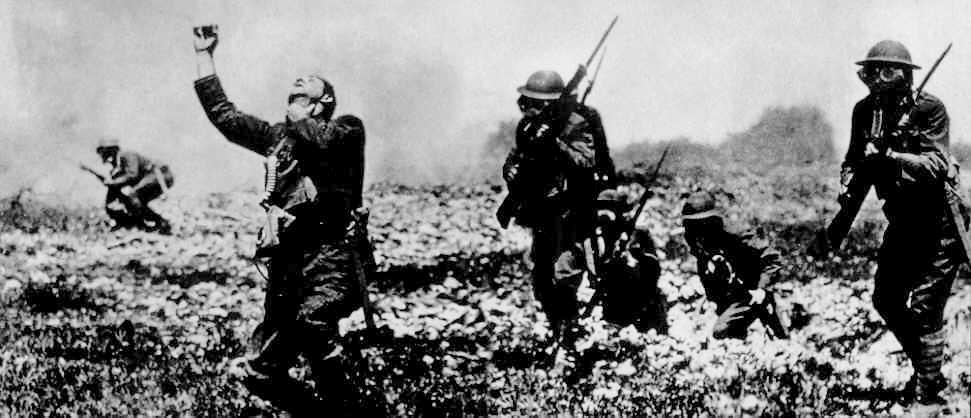
January 29, 1915, a British soldier at the Second Battle of Ypres, in Western Belgium.

January 29, 1915, a British soldier at the Second Battle of Ypres, in Western Belgium.

Certainly the 20th Century was a mess for all creation with the Great War erupting, though none of the participating European countries initially had a compelling reason to fight. Nonetheless, the war destroyed a generation of young men in Flanders field and on other pointless killing fields. Our 7th-grade English teacher had us memorize the poem In Flanders Fields, written by John McRae, a Canadian officer who wrote it for a fellow soldier killed at the Second Battle of Ypres in 1915. Later in the war, McRae also died.

In Flanders Fields the poppies blow
Beneath the crosses, row on row,
That mark our place; and in the sky
The larks, still bravely singing, fly
Scarce heard amid the guns below.

We are the Dead. Short days ago
We lived, felt dawn, saw sunset glow,
Loved and were loved, and now we lie
In Flanders fields.

Take up our quarrel with the foe:
To you from failing hands we throw
The torch; be yours to hold it high.
If ye break faith with us who die
We shall not sleep, though poppies grow
In Flanders fields.

Writers have called World War I an end of innocence, which it probably was for many. But every war has been an end of innocence for that generation as well.

Innocence most certainly, and sadly, ends. But it is hard to say innocence ever had a fighting chance as humankind has somehow survived through disease, pestilence, drought, floods, tornadoes, hurricanes, volcanic eruptions, superstition, inquisition, religious war, hunger, starvation, bigotry, prejudice, stupidity, mental illness, genocide, and mass murder.

Phew!

Daddy with his only granddaughter Abby.

My 80-year-old father Roy with his granddaughter Abby – Thanksgiving 2015.

However, for all the conflagrations of bad news and horrors visited by humankind upon each other, nature upon humankind, and humans on nature, life abides and love flourishes. And there is indeed light in the world. The sun comes up, joy glows from tiny human faces as well as the sweet smile of my 80-year-old father. He may have dementia, but he holds my hand firmly, puts his arm around me, and gives me such a delicate kiss when we say good-bye.

What brought me to this particular epiphany was the loss my father suffered throughout his life because he had no mother, as he said to us countless times. Daddy’s mother, Darcas, died at the age of 31 when he was only four months old.
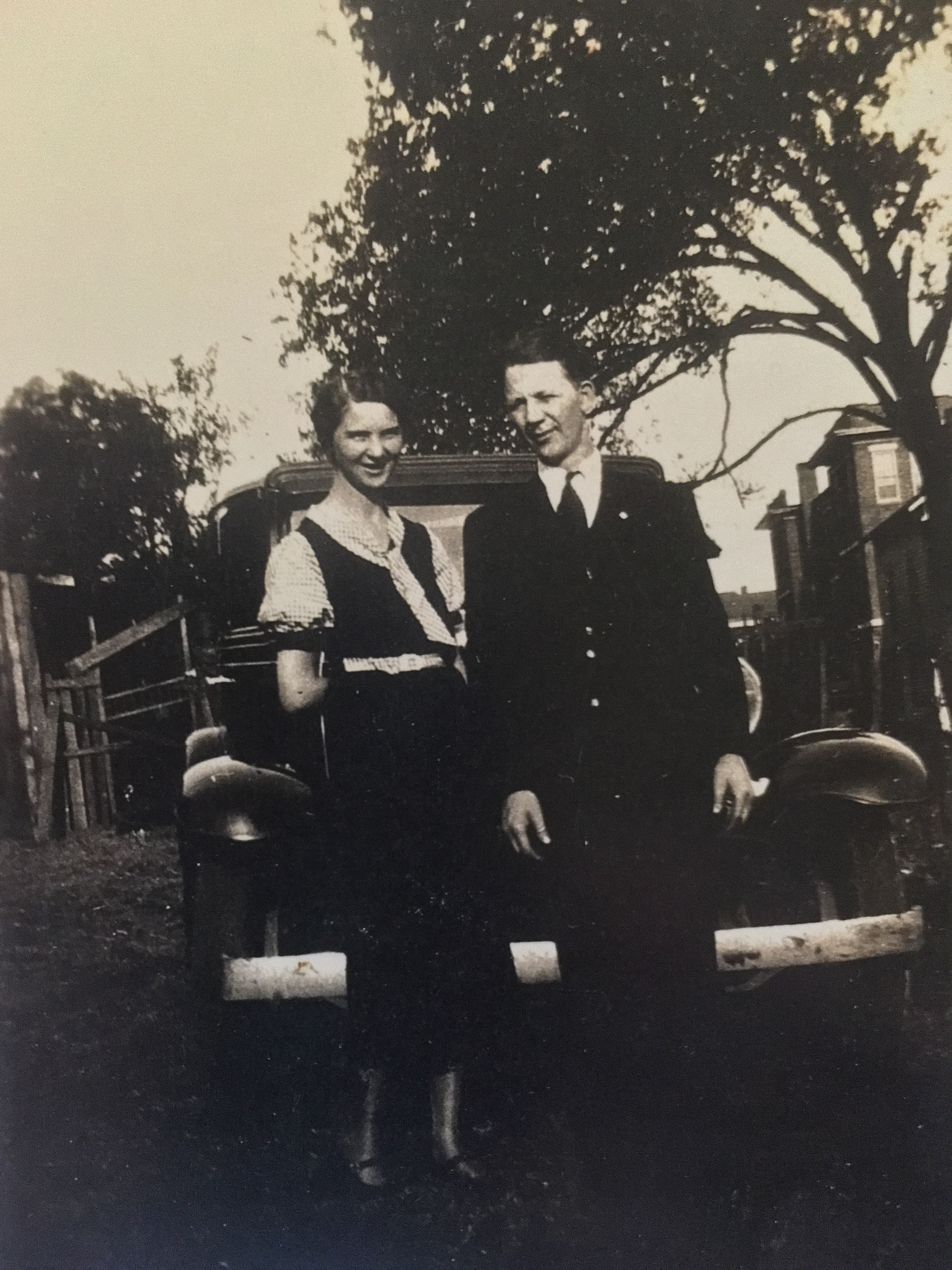
My dear grandmother, Darcus Montgomery, with my grandfather Hodge Allen, on their wedding day in 1934.

For nearly 80 years Daddy never knew why his mother died, and for 78 years he had never seen a photo of her face. But by chance while visiting Daddy’s cousin, Evelyn, in her assisted care facility, Mama noticed a photo of Daddy’s father seated beside a woman, presumably on their wedding day. Darcas at last–and Daddy was able to see what she looked like for the first time. Amazingly no one in Daddy’s paternal family had thought to share this picture of his mother.

Daddy was ecstatic to see her for the first time, but his cousin would not give him the photo. So my husband Kurt and I, along with my parents, visited her, and Kurt snapped a photo of the picture so Daddy and the rest of our family could finally see the woman who gave Daddy life: Darcas Nickaline Montgomery Allen.

That was just the beginning  of our journey to find the missing side of Daddy’s family. Through a peculiarly wonderful piece of luck, fate, or good fortune, Daddy’s mother’s family was (and is) Mormon, and they are people who care deeply for their ancestors. This fact has helped us immeasurably as we have followed the barely visible crumbs of information leading to my father’s Montgomery family. We finally found and contacted what we found to be the grandchildren of Darcas’s siblings and will soon be able to show Daddy photos of his mother when she was young and happy–before she died in 1935 of pellagra psychosis, a nutritional disease leading to madness.

Cordelia and John Montgomery with their children Robert 5, Darcas 3, Eutaw 1, and Adrian 9.

A photo shared by Eutaw’s granddaughter: Cordelia & John Montgomery in 1906 with their children Robert 5, Darcas 3, Eutaw 1, and Adrian 9.

Through the reminiscences of her Montgomery family (and a photo of the family in 1906), Darcas came to life: She was sensitive, child-like, loved children, but was afraid to have children of her own. She was especially close to her sister Eutaw Regina who was two years younger, and together they worked in a cotton mill in Virginia, then one in Tennessee, as teenaged spinners. Eutaw and Darcas were the only two daughters in the family who lived past childhood with their parents, John and Cordelia, losing three small girls: Rose Elizabeth lived one day, Willie Hazel died at 1-1/2, and Luva Vera was 10 when she died of the Spanish influenza that swept the world in the wake of World War I. Sadness and loss of innocence also visited Carroll County, Virginia, as they were put to rest in the small family cemetery.

Although her mother and sister sheltered and protected her, Darcas undoubtedly was devastated by the death of her little sisters which probably increased her fear of having children of her own. Yet, at some point, she met Hodge Allen and decided to move 100 miles away from her family to start a new life in Knoxville, Tennessee, with this good-looking, but barely articulate, man. Like her, he had not married until his 30s and had always lived with his mother.

What she, a sheltered Mormon who was probably raised not to drink coffee or alcohol, could not have known was the maelstrom she was entering by living with Hodge, his mother, and his alcoholic brother. Daddy remembers bootlegging, “women”, the abuse of his drunken uncle, being threatened with a hot poker, and the scar on his cheek that he was told was from a rat bite he received when he was a baby.

"Rothie" as his Allen family called Daddy, w/Hodge around the time his mother died in 1935.

Hodge holding “Rothie” as Daddy’s Allen family called him, around the time his mother died in 1935.

Just 18 months after her marriage and four months after giving birth to Daddy, Darcas died a monstrous death in the county’s combination insane asylum and workhouse for the poor, the George Maloney Home. Daddy’s illiterate father, Hodge, did not have the money or the wherewithal to have his wife committed to the state’s facility (Eastern State Psychiatric Hospital in Knoxville) where she might have received better care. Nor did he–as far as we know–contact her family in Kingsport about her illness until after she was dead. According to her family, Darcas was never able to hold Daddy after his birth.

It was a tragedy that Daddy never felt a mother’s love, his upbringing was grim, and he was thrown out of his home by his second stepmother when he was 16 and lived for a few years at the YMCA. Heartbreaking. And I would have so loved to have known my grandmother. But suddenly it dawned on me, that I do know my grandmother because I know my father. The description of Darcas shared by my Eutaw’s granddaughter describes Daddy as well: emotionally and physically fragile, sensitive, and somewhat child-like. Just as her mother and sister protected Darcas, my mother, sister, and I have tried to protect Daddy. His naiveté, childhood neglect, and temperament have never made him a good fit for the harder jolts of life.

But he lived through his abusive, motherless childhood; he and Mama effectively reared two daughters who have been able to make their way in the world; and he adores his family. He was not a good provider, but he is a good man.

Darcas's grave shows no exact date for her death because they were not sure when she died.

Darcas’s grave shows no exact date for her death because they were not sure when she died.

So I know my grandmother Darcas–my wish has been granted. I never got to hear her voice or hold her–and she never got to hold Daddy–but in October I finally stood beside her grave and felt her sweet spirit as the wind blew over her family’s cemetery on what used to be the family farm. And, as singer/songwriter Feist wrote in her whisper of a song: I caught a long wind under my wings.

Little bird have you got a key?
Unlock the lock inside of me
Where will you go?
Keep yourself afloat
Feeling old until the wings unfolded
Caught me a long wind

Where will we go?
Keep ourselves afloat

I caught a long wind
A long life wind

Like a swallow
A night owl
A little chickadee
Sad sparrow
Good morning bird
Good nightingale
I took a deep breath
And caught a long wind

The Montgomery family cemetery beside rows of corn still in the field.

The Montgomery family cemetery in October 2015, alongside rows of corn still in the field. My grandmother rests near the evergreen bush between the two trees.

We caught a long wind, my grandmother and me. And we flew, together, at last.

//Anna – 12/31/2015

Posted in Autobiographical, Blooming, Childhood, Courage, Family, Home | Tagged , , , , , , , , , , , , , , , | 2 Comments

More Than Enough

College graduation day with my grandmother and my son Justin

College graduation day with my sweet grandmother and my son Justin

For all those of you who believe your life is over when you turn 30 or 40 or 50, I have a secret for you: I have passed those milestones and have never been happier, looked better, enjoyed life more, or felt more hard-won joy. When I was in my 20’s, I was a single parent putting myself through college with an ex-husband alternating between stalking me and not paying child support.

My 30’s were spent giving birth to another son and fighting for custody of him after another failed marriage. Once I heard a saying that life is like learning to play the violin in public, and I certainly did a lot of tuning my instrument!

Daddy being moved from the hospital to the rehab center. With my sister Lisa in the left foreground.

Daddy being moved from the hospital to the rehab center. With my sister Lisa in the left foreground.

Lately I have been writing about my father and this roller coaster our family has been on with him: from last month considering hospice options, to this month finding ourselves with Daddy miraculously back in our lives with his infectious huh-huh-huh laugh, impish playfulness, sweet temperament, and generosity of spirit.

On Thursday we had the best Thanksgiving I have ever experienced as we–hold onto your hat–had lunch in the family dining room of Daddy’s assisted living facility. I know what you are thinking–put rose-colored glasses on a half-empty situation, Anna–but this was not the case. Everything about this day was perfect, and I was reminded again that we have the most fun together as a family.

Justin and his fiancee Tracy; Abby and her boy friend Holden--with the ubiquitous photo bomber

Justin and his fiancee Tracy; Abby and her boy friend Holden–with the ubiquitous photo bomber

Last month Daddy was so weak and had lost so much weight that he was incapable of walking without assistance. On Thanksgiving he walked slowly and not only put up with our antics, but laughed himself silly as I relentlessly photo bombed my son Justin and his fiancee Tracy, and my niece Abby and her boy friend Holden. We like to set a tone of total merriment, and I landed squarely on that shore.

Pointless rules, ungrounded worries, trying to live up to other people’s expectations: I have found it a total waste of time. Living in fear and not fully being yourself is not the way to live, and many of us find that being ourselves is less difficult in our middle and later years.

My son Justin, Daddy, me, Mama, and Justin's fiancee Tracy.

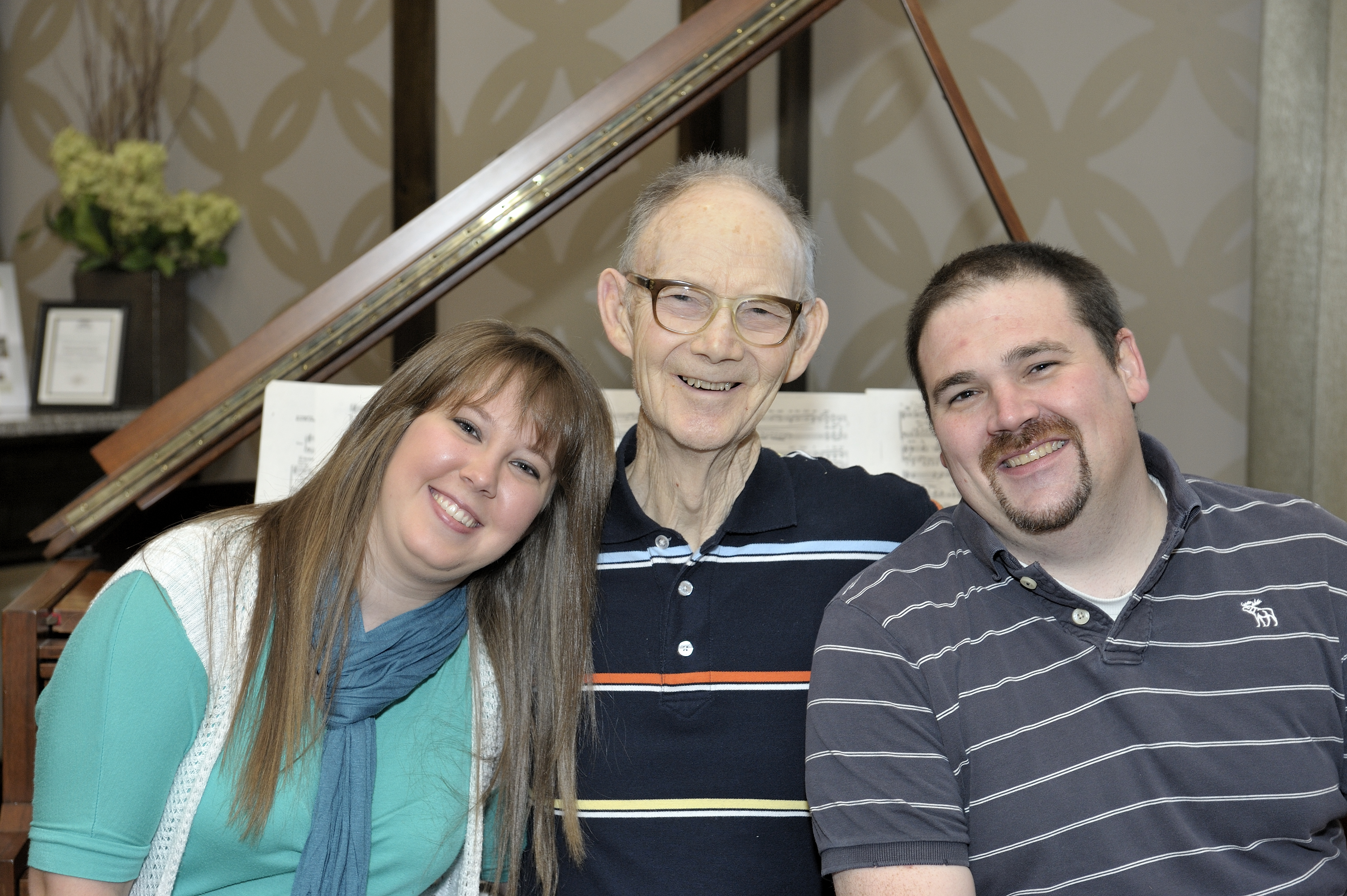
My son Justin, Daddy, me, Mama, and Justin’s fiancee Tracy at the piano.

At the age of 79, my mother is finally coming into her own after taking care of first her mother, then her father, followed by her disabled brother, and then my father who has dementia. As a girl and young woman, she was especially close to her grandmother, has always had a natural affinity for the elderly, and she took care of all of these loved ones without missing a beat. However, just in the last week I have seen another Mama who is spontaneously gleeful and fully in command of her own money and decisions. She has never been one to smile much in pictures or show much emotion, but here she is fully feeling her oats.

After experiencing many frightening episodes and Daddy’s losing down to just 133 pounds on his 6-foot-two frame, Mama came to the conclusion that she could no longer care for Daddy at home. Her earlier reticence to consider assisted living for my father have been unfounded, however, because Daddy has been transformed during the week he has lived  in his new home, a just opened facility called Oakwood Senior Living where he is eating (unlike at the hospital and rehab center), gaining weight, playing a bit of pool at the facility’s pool table, walking without assistance, and encouraging his mostly female neighbors. Mama is there everyday, most of the day, since he refuses to eat meals without her, but we magically have Daddy back again–so anything beyond this is entirely gravy.

Daddy with the "son" he never had and the couple he simply adores: my son Justin and his fiancee Tracy

My sweet Daddy with the “son” he never had and the couple he simply adores: my son Justin and his lovely fiancee (and accomplished pianist) Tracy

We play 100-piece puzzles with Daddy in the huge communal room of the memory care unit that is well appointed with a big-screen TV, large dining room, and comfortable seating. And here’s another epiphany: there is joy in Daddy’s face each day that I have not seen for years. And that is definitely more than enough for me!

Anna – 11/28/2015


Posted in Autobiographical, Blooming, Courage, Family, Happiness, Home, Joy (Joie de General) | Tagged , , , , | 3 Comments

The Cure for the Pain

Daddy at the hospital October 13, 2015By some peculiar alchemy of dementia, there are flashes of light when the seeming blindness of Daddy’s soul and withdrawal from everything around him subside. At those moments, there is a window to Daddy who is occasionally still there in his once 6-foot, 2-inch body that now weighs only 133 pounds–eight pounds more than I do, his 5’4″ daughter. When I hear singer-songwriter Gretchen Peters’ song The Cure for the Pain, I think of Daddy and this captive journey we are on.

damn this lump in my throat
damn this hole in my coat
damn this rain that just won’t quit
damn the sorry waste of it

There he sat in the hospital emergency waiting room’s wheelchair in an unseeing vegetative state, his hunched-over body waiting–uncaring, and unresponsive–as we, his family, talked around him. After we finally scored him a bed, he became impatient and belligerent when he could not follow the ER doctor’s questions or orders. “Can you follow my finger with your eyes, Mr. Allen?” No, he could not. At times it wasn’t at all clear that he knew us. He wanted up, and although he was too weak to stand, we had to ask for medication to keep in bed.

damn the truth, and damn these lies
damn that look behind your eyes
damn this day, damn this night
and damn this losing fight

It has been years since I have really seen my father. When I visited my parents recently, Daddy has seemed entirely divorced from himself with no one at home in his eyes. Uncomfortable, miserable, never satisfied–that has been his life. And sitting alone in the basement, too cold to come upstairs even in the heat of summer.

Yet, the morning after he got a hospital room, he smiled at me ever so sweetly, the lights back on in his mind. He winked at me with one eye, then magically the other and said, “You have always been my favorite daughter, Anna,” to which I could only say, “I know, Daddy, but we won’t tell Lisa.” He added, “I love you soooo much.”

“I love you too, Daddy.”

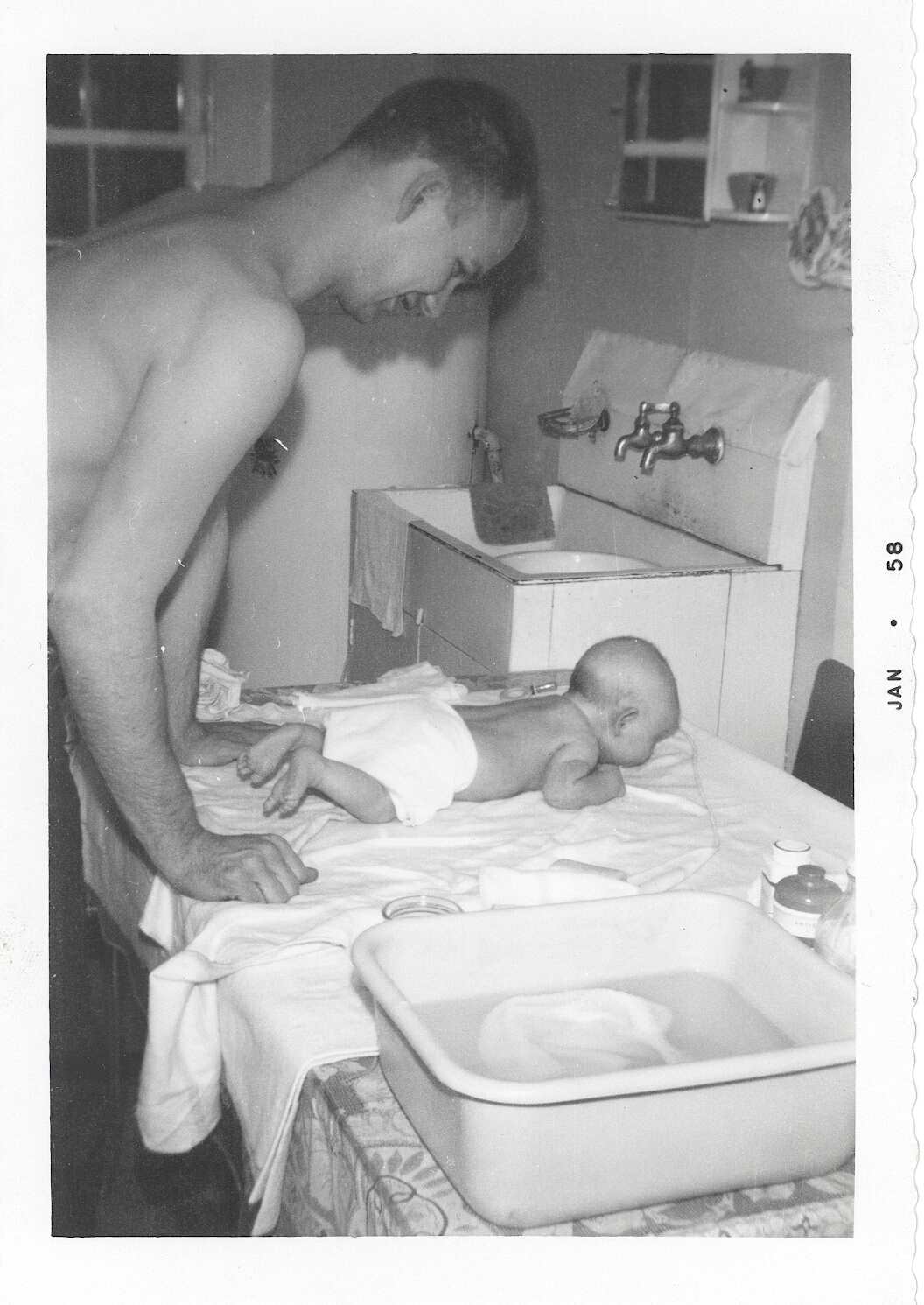
Daddy giving me a bath when I was a baby.

Daddy giving me a bath when I was a baby.

Perhaps our closeness comes from the fact that he took care of me as a baby while Mama worked, or because we are more alike than Mama or my sister Lisa. But he has never left any doubt that he loves both “his girls” and has been soooooo proud of his daughters: Lisa the popular cheerleader and me the bookworm.

it’s not like you think it’s gonna be
not like the movies that you see
ain’t no soaring violins
just machines and medicines

A half biscuit for breakfast, a few carrots for lunch, a bit of peach cobbler, and the days’ meals go untouched. The water was not hot enough, but then too cold, he won’t take his pills, oh, how this gets old.

so bless these pills, bless these sheets
bless this food that you won’t eat
bless the damned who walk these halls
and god have mercy on us all

I talked to the house doctor and got his perspective; listened as the social worker outlined resuscitation scenarios; argued with the case manager for a better rehabilitation center; went to lunch, came back and Mama had already signed the papers for the rehab center nearby. So the next day he was off to rehabilitation although rehabilitation for what we did not know.

Daddy being moved from the hospital to the rehab center. With my sister Lisa in the left foreground.

Daddy being moved from the hospital to the rehab center with my sister Lisa in the left foreground.

Somedays at the center my father is content to stare at the muted TV, doze after therapy, smile sweetly, and kiss my hand. But other visits do not go as well. “I want to know which of my daughters, you or Lisa, love me the most. Which one of you will take me home?”

“That one over there,” he pointed to Mama, “Won’t take me. So I want to know, Anna, do you love me? I’ve done what they told me. I did my therapy, the bike, walked the steps like I do at home. I want to go home.”

“You need to stay here and get better, Daddy,” I offered weakly. He look at me witherly and declared, “Lisa loves me; she’ll take me home.”

“You need to stay here, Daddy.”

He would not look at me directly, but cut his eyes occasionally in my direction. When I asked the nurse to give him another pill to make him calmer, he refused to take it. Then  he pointed to me and told the nurse, “I’ll take it if she leaves the room.”

there ain’t no boat, there ain’t no train
to take us back the way we came
ain’t no shelter from this hard rain
the cure for the pain is the pain

A few years ago Daddy was told he had dementia, and would say to us, “Dementia’s bad.” His psych doc said he probably had Alzheimer’s and should not drive, but he continued driving anyway. He bought a new SUV, and promptly drove it through the back of his garage into the yard, completely totally the car. The brake malfunctioned he said, but it was clear he mistakenly pressed the gas pedal instead of the brake.

His paranoia worsened and he slept with a loaded revolver under his pillow; the doctor said it had to go. After the second attempt, we got it out of the house. Daddy was furious, replaced the gun’s spot under the bed with a hatchet, and told Mama there were knives in the kitchen, and he would kill himself if he didn’t get his gun back.

When his threats did not get the desired result, Daddy asked Mama to have my sister bring the gun back unloaded. Although Lisa did not return his gun, Daddy drove to WalMart for a box of ammunition while Mama was at church. Mama found the ammo in his closet this week.

there ain’t no drug, there ain’t no cure
to make it like it was before
ain’t no shelter from this hard rain
the cure for the pain is the pain

My dear grandmother, Darcus Montgomery, with my grandfather Hodge Allen, on their wedding day in 1934.

Daddy’s mother Darcas Montgomery Allen died when he was four months old, so he never knew her. Only a few years ago he saw what could be a picture of her when Mama noticed a picture on the wall of Daddy’s cousin Evelyn’s room at her assisted-living facility.

Since Daddy’s father married three times, we could only guess that the photo might be Daddy’s parents on their wedding day in 1934. My father’s dad Hodge and his relatives told Daddy little about his mother: that her family was Mormon, her brothers lived in Kingsport, Tennessee, and she was buried in Virginia.

After years of Internet and local geneological research, my husband Kurt and I set out for Carroll County, Virginia, a few days ago to bring back photos of Daddy’s mother’s grave and any information about her family that we could share with him before his memory was completely gone.

Carroll County pioneers William and Rachel Montgomery had come from Ireland to Virginia in the mid-1700’s, and acquired hundreds, perhaps thousands, of acres of land. This was and is fertile farm country and in the intervening centuries, most of the Montgomery family descendants have sold their farms leaving family cemeteries on what had once been their land. After visiting four or five such family cemeteries that were not my family’s resting place, we got directions and a map from the local funeral home, and asked directions of a lovely woman who lived near the site. Without the help of these warm and wonderful people of Carroll County, we would never have found the site in a huge pasture with a fenced-in area near a grove of trees. It was cold, raining, and windy as we walked to the gate.

The sign at my grandmother's family cemetery in Carroll County, Virginia.

The sign at my grandmother’s family cemetery in Carroll County, Virginia, and me in the background.

The first few graves to the left of the entrance were distant relatives followed by my great grandparents’ John Martin and Cordelia Montgomery’s graves. When I saw my grandmother Darcas’s gravestone between her mother and her little sister Luva Vera who lived to be only 10 years old, tears ran down my cheeks. I was so happy to have finally found her and sensed her sweet, serene, humble spirit on that cold rainy October day.

The grave of Darcas Nickaline Montgomery Allen, Daddy's mother

The grave of Darcas Nickaline Montgomery Allen, Daddy’s mother

Buried beside Darcas and Luva Vera were their sisters Rose Elizabeth, who lived only one day, and sweet little Willie Hazel, who lived to be only 1-1/2 years old. Heartbreaking the loss of so many children, as well as Darcas who died at the age of 31, just a month before her 32nd birthday.

Darcas’s brothers Robert and Clarence, as well as Clarence’s wife, Janie, were buried at the family cemetery as well.

After Darcas’s father sold their 35-acre farm in 1917 when she was 14, Darcas and her family moved to neighboring Grayston County where she and her sister Utah, who was two years her junior, worked as spinners in a cotton mill located in Fries (pronounced Freeze), Virginia.

I walked the path my grandmother walked when she went to work at the cotton mill as a teenager.

I walked the path my grandmother walked when she went to work at the cotton mill as a teenager.

The town was a new one created around the mill in 1903 and ran with the electric power from a dam placed on the swift running river beside the mill. It was a wonderful feeling to walk the path my grandmother would have walked when she went to work each day.

The mountains and woodlands were gorgeously full of color, and we were so happy to have photos to share with Daddy and allow him to see his mother’s grave for the first time. Since I had a realtive’s name, a Kingsport address, and a phone number which was on the family cemetery gate, I left a message for my distant relative telling him that we hoped to get to know him and his family, and would be pleased to receive copies of any photos he can share with us of Daddy’s mother and family–before his dementia closes that door to him.

When I got back to Knoxville and went to see Daddy at the rehab center, I showed him the photo of his mother’s grave. He said, “She died when I was a baby.” And I said, “Yes, she did.” It appeared to me he had trouble taking in the enormity of this new information, but when Mama visited him that evening. she asked him about it, and he remembered the photo.

So, for us, the cure for the pain is the love of family–the family we have known all our lives as well as the family we know only in spirit–and doing what little is left to us to follow that line of hope and close the circle of love.

— Anna, All Hallow’s Eve, 10/31/2015

Posted in Childhood, Courage, Love, Tribute | Tagged , , , , , , , , , , | 5 Comments

My Hand, Always in Daddy’s Glove

Mama and Daddy on their wedding day in 1956

Mama and Daddy on their wedding day in 1956

In his black-and-gray herringbone coat with his bitten-short fingernails, Daddy would come through the door after work. That is my first hazy memory from childhood.

I am not sure why I remember Daddy’s coat and his nails as the same memory, but I recall the safe feeling I had when I saw Daddy come home after work. Daddy was “home”. Maybe it goes back to him taking care of me when I was a baby while Mama worked at Great Atlantic Shoe Company. But probably not. He was my sweet Daddy, incredibly handsome, and my ideal for how a man should look.

My sister Lisa and me in the snow outside our home, 1963

My sister Lisa and me outside our home in 1963.

Recently I heard Tori Amos’s song “Winter” that she wrote for her Father’s Day it triggered memories of how I felt about my father when I was young, and perhaps how I still feel about him now.

One long ago Valentine’s Day, I remember Daddy bought each of his “girls” (Mama, my sister Lisa, and me) red Valentine boxes full of candy hearts with tiny phrases such as “Be Mine”, “Love You”, and “Be True” written on them. I felt so special–one of Daddy’s girls. In her song, Tori wrote:

Snow can wait, I forgot my mittens.
Wipe my nose, get my new boots on.
I get a little warm in my heart when I think of winter,
I put my hand in my father’s glove.

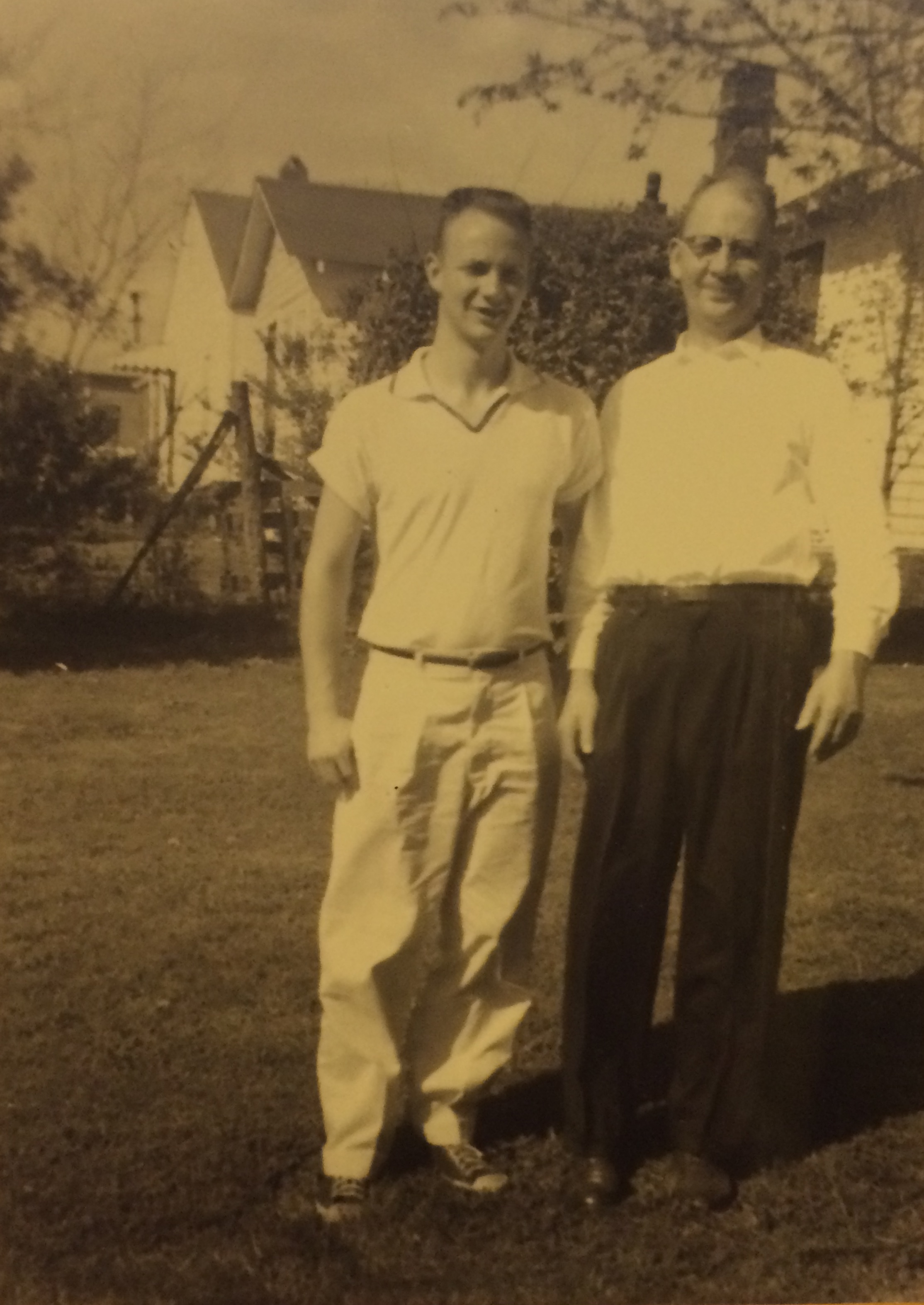
Daddy with this father in the backyard of Mama's childhood home, in about 1955

Daddy with this father in the backyard of Mama’s childhood home, in about 1955

Although Daddy was 6’2″ before old age took off a few inches, he was not really a towering presence, but a fidgety, nervous man when he was not engaged with something. Never having a mother, since she died when he was four months ago, no doubt affected Daddy’s sensitive nature. “I have a nervous stomach,” he would tell us. And he was not the least bit mechanical–couldn’t fix anything around the house or with the car–so when anything went wrong it was always Papaw, Mama’s father Tom Henderlight who fixed it.

But Daddy was fun-loving, constantly playing his meticulously cared for collection of 45s from the 1950s. My sister Lisa and I could sing all the words to the songs (and, by the way, we still can!). As a motherless child growing up in the 1940s and early ’50s, Daddy spent as much of his teen years’ time as possible with the flickering images of the movie theaters in downtown Knoxville.

Mama had never seen a movie until she started dating Daddy and she didn’t seem to care little for them, but we girls loved going. Daddy would take us to the Tennessee Theatre where, after an Orange Julius and a dip dog from across the street, he would regale us with how fine the theater was with its rotunda ceiling and ornate fixtures. He talked ceasely about his favorite actors and movies: “Broken Arrow” with Jeff Chandler or anything with World War II, war-hero turned-movie-star Audie Murphy.

Whatever Daddy believed, he felt strongly and would broach no disagreement. He never doubted he was right, even when he couldn’t have been more wrong. But he adored his girls, and I felt protected by him and protective of him as he would lick his thumb methodically each time he counted a bill out of his wallet to pay for things.

Between my first- and second-grade years, I won a summer competition for reading more library books than any child at our branch of the library. My sister Lisa was a cheerleader and very popular at school. Daddy was so proud of us and constantly told anyone within earshot of our accomplishments.

Tori Amos’s writes from her father’s point of view and then her own as she continues the song’s lyrics:

When you gonna make up your mind?
When you gonna love you as much as I do?
When you gonna make up your mind?
‘Cause things are gonna change so fast,
All the white horses are still in bed,
I tell you that I’ll always want you near,
You say that things change my dear.

Even though Daddy was very meticulous and a perfectionist about details around him, his inability to broach disagreement with his opinions did not put him in good stead at work. Each time he lost his job it was a new crisis for our family. First he lost his job as a bookkeeper at House-Hassan Hardware, then he was let go from another bookkeeping position at White Lily Flour Company where he explained they had put in a early version of a computer to replace him.

Then he took a job at Kern’s Bakery where he and the other inside-plant workers had to take salt pills to replace the nutrients they sweated away as they worked around the hot bread ovens. After paying his dues working two years inside the sweltering bakery, Daddy earned his own bread route, delivering Kern’s Bread to Rutledge and Granger County.

Daddy’s was not one of the best routes, but he was immensely proud of it as he took Mama, Lisa, and me on a tour with the highlight being the Krystal-like hamburger joint that was one of the stops on his route.

“This is my wife, Arzelia, and my girls, Anna and Lisa,” he would say as he proudly introduced us to the waitress and the cook. We were proud of him right back as we sat on our high barstools and bit into our hamburgers inside the heavenly moist Kern’s hamburger buns, with a side of fries, of course.

When he lost that job a few years later, Daddy explained, “They don’t like it that I’m a Christian and won’t drink with them, and they are always cussing and going on”. Then he took a job delivering magazines for Anderson News for a few years, which ended when the company cut back on its routes.

To make ends meet during these early years, Mama, Lisa, and I worked Friday and Saturday nights at our Aunt Helen and Uncle Bunt’s newly opened restaurant, Ye Olde Steak House. Mama also worked at the other thriving South Knoxville family business, Stanley’s Greenhouse, while Daddy worked through the night on Saturdays collating the ad sections into the Sunday Knoxville News-Sentinel newspaper. He thrilled to tell us about the huge presses and conveyors that printed and transported the papers. And there was a big plus from Daddy’s point of view: he got to read the sports page before anyone else! Because, let’s face it, Daddy was obsessed with sports.

My father had no middling feelings about anything, just strong ones, pro or con. His temper would occasionally flare over sports disagreements, and then we no longer visited those particular offending relatives who favored Maryville High School over Daddy’s own beloved South High basketball team. At these times, my sister Lisa and I kept our heads down so we would not wander into the crossfire when Daddy was upset.

Since his mother died of pellagra psychosis, a catastrophic nutritional deficiency, when he was only four months old, Daddy grew up desperately poor with his ineffectual, illiterate father and his abusive, alcoholic uncle. For the first few years of his life, he was reared by his grandmother, but after she died when he was 5 years old, Daddy was virtually an orphan. Growing up in this chaotic environment without a mother left Daddy sensitive and high strung. The pressures and responsibilities of earning enough to raise a family rested heavily on Daddy–and Mama as well.

My graduation from college in 1987 with Mama and Daddy

My graduation from college in 1987 with Mama and Daddy

However, Daddy could not have been more proud of our accomplishments. After I earned my bachelor’s degree by putting myself through the University of Tennessee while working full-time as a UT secretary (and raising my son, Justin, as a single parent), no one was happier than Daddy.

And Daddy was very proud of my sister Lisa’s entrepreneurial instincts as she joined her husband Rocky’s family business, Stanley’s Greenhouse, eventually to share management of the customer service side of the business with her brother-in-law Monte. Mama had already been working there for 20 or so years, and soon Daddy came on board to make Stanley’s even more of an all-in-family affair.

Daddy loved strongly, and he adored UT’s legendary Coach Pat Summitt who inspired young women around the world as a Olympic champion and Lady Vol coach. Pat was hired to coach the Lady Vols at the age of 22 when women’s basketball was little more than intramural, and she built the program from nothing to national-championship level in only 15 years.

Pat’s teams caught Daddy’s imagination and my parents started taking my son Justin to games when he was 5 years old. Since I was communications director for the fund-raising arm of the university, it was easier to get our family season tickets together and going to Lady Vol games became a defining passion in Daddy’s life. My parents traveled around the world with the Lady Vols as they played tournaments in Greece, Italy, Alaska, and Hawaii.

Daddy loved the Lady Vol players and coaches, and hated the referees who called fouls on them and the University of Connecticut who were our arch rivals. With Daddy everything was personal.

Hair is grey
And the fires are burning
So many dreams
On the shelf
You say I wanted you to be proud of me
I always wanted that myself

In a curious and tragic coincidence, both Pat Summitt and Daddy were diagnosed with Alzheimer’s around the same time in 2011. Heartbreakingly unbelievable to all her admirers that Pat Summitt’s fabulous mind for complex game strategy–a woman named one of the two best coaches, male or female, in basketball history by Sports Illustrated in 2011–was stopped in her prime by this wicked, wicked disease. People across the country and world celebrated her achievements and courage as she took on this scourge of the human mind and spirit.

A very individualized disease, Alzheimer’s affects each person differently, and Daddy’s version also progressed faster than we wished. He lost a bit more of himself with each year.

‘Cause things are gonna change so fast,
All the white horses have gone ahead
I tell you that I’ll always want you near,
You say that things change
My dear.

Daddy in the middle of our family's group Christmas photo, 2013

Daddy in the middle of our family’s group Christmas photo, 2013


Coming to terms with the inexorable, bit-by-bit loss of Daddy has been a reckoning with our family’s past, my childhood, and the ghosts of our family’s triumphs and failures. I have struggled to find a proper denial zone in which not to think about losing him in this way.

I have tried instead to pitch my tent in the land of gratitude that even though the Daddy that held my hand when we crossed the street when I was young was not all there these last few years, in some ways he was more himself than ever as he put down some of the burdens of being a motherless child. Now the sun of his day is Mama who has lovingly cared for him daily, every day. The world is in Daddy’s sweet smile: he would smile at me, then wink; I would smile back, and wink.

I tell you that I’ll always want you near,
You say that things change
My dear.

Things do change, but I will always be my Daddy’s daughter, and as long as I am alive, the part of him that gave me life and gave me his love will always be with me. When I was unhappy about something as child, I always hated it when Daddy would say to me:

You have to take the sour with the sweet, Anna.

If only it wasn’t ever so. But my hand will always be in Daddy’s glove.

Anna — 9/30/2015

Posted in Autobiographical, Blooming, Childhood, Freedom, Happiness, Home, Knoxville, Uncategorized, Writing | Tagged , , , , , , , , , , , , , | 3 Comments

Coming Up Short in a Small-town City

My sister Lisa and me

My sister and me in 1963, the year I started school

When I was growing up here in the South in the valley near the Great Smoky Mountains National Park, my hometown of Knoxville seemed organized, adults had rules, my sister and I enjoyed a good many snowfalls, and I could stand in the floorboard of my parents’ car without bumping my head on the car’s roof. Grown ups couldn’t do that, and I was proud that I could.

That was the only time I remember being happy to be small. Besides being the youngest girl in my 1963 first grade class, I was also the shortest and was paired with Mark, the shortest boy, for the square dances we were taught. He was none-too-happy to be so designated and to be stuck with me, the shortest girl. But I loved square dancing, and Mama has pictures she took with her tiny, square Brownie camera of our skirts swirling as we twirled from partner to partner. It was great fun to know what we were supposed to do, and to do it so beautifully together.

We were taught songs from other countries, cultures, and religion. We were probably the only public school children in the 1960’s American South that were taught the Jewish Chanukah song Dreidel, Dreidel, Dredel:

I have a little dreidel. I made it out of clay.
And when it’s dry and ready, then dreidel I shall play.
Oh dreidel, dreidel, dreidel, I made it out of clay.
Oh dreidel, dreidel, dreidel, then dreidel I shall play.

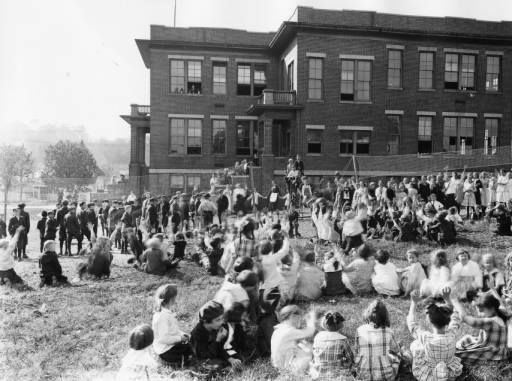
An elementary school in South Knoxville - 1950's.

An elementary school in South Knoxville – 1950’s.

Perhaps our teacher needed no more prompting to teach us a Jewish holiday song than the fact that we had two Jewish children in our otherwise Gentile public school. None of our parents were upset when we learned a Jewish song, our world was expanded to know that some children celebrated different holidays from us, and knowing the words to Dreidel helped my team win a song lyric competition years later at a holiday party. Ha-ha!

But my town no longer seems so organized, the decisions made by those in authority don’t always make sense, and I can no longer stand upright in the floorboard of my parents’ car.

My graduation in 1987 with my parents.

My 1987 graduation from college with my proud parents

Graduation day with my grandmother and my son Justin

Graduation day was shared with my sweet Irish grandmother and 7-year-old son Justin.

With the help of government grants, scholarships, and tuition wavers (as I worked full time as a secretary at the University of Tennessee), I earned my bachelor’s degree in English literature and writing at what I felt then was a ripe old age of 29.

I was the first person in my family to go to college, and my parents, grandparents, and 7 year-old son were proud of my achievement. A failed early marriage made me older than the typical student, but as soon as I left my controlling husband–who would never have approved of my education–I re-enrolled in college. Working at the university made it easier to attend classes, and my parents kept my son, Justin, when I had classes at night.

After working my way up at the university in a series of jobs with more responsibility, I was hired as what they called “the writer” for the university’s fund-raising office. For 19 years I worked in a big, statewide family–dysfunctional at times no doubt, also occasionally crazy-making, bureaucratic, political, and dispiriting. But the university was my home. In some respects, it reared me from a 17-year-old, first-time student in 1975, a young divorced mother at the age of 24, a graduate at 29, and a mid-level administrator at the age of 34. I learned how the world worked and how I should treat people from my mentor when I was his secretary who told me, “Don’t call me Dr. anything; call me Bob.”

As a communications director, I polished our university’s face with prose. I shared the stories of the people who gave money to the university so our students could learn from the wisdom (and folly) of the ages; our colleges could hire and keep promising professors; our researchers could find better answers for the scourge of disease; our libraries could have the latest books; Tennessee could have more doctors, dentists, and veterinarians; our world’s farmers could have healthy crops; and our students could test themselves in athletics. The university researched and shared the length, breadth, and depth of our world’s experience. And we were proud to do our jobs for the people of one of the country’s poorest, but proud, states: Tennessee.

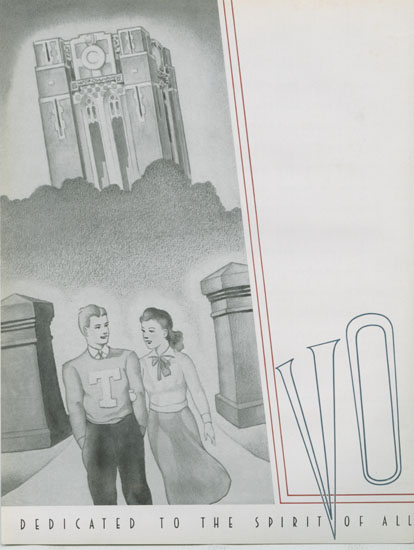
The 1940 yearbook's dedication to "all volunteers to come in the future."

The 1940 yearbook’s dedication to “all volunteers to come in the future.”

During one of the university’s ubiquitous reorganizations, a nearly complete set of the university’s yearbooks fell into my care. They were an entire history of all the giddy joy that our students experienced from the first yearbook in 1897; through the war years; into the rosy, GI Bill, post-war 1950s; into the turbulent, questioning ’60s, ’70s, and beyond. It was all there, and I loved caring for those memories: all the fresh-faced hijinks and world-made-new possibilities with every new freshman class.

In the early years of my time at UT, the university had long-serving and adept leaders who knew how to get the support we needed from the state, cared deeply and personally for our people, and inspired us to follow their lead. They were not particularly concerned about national rankings, but whether we were providing a good, solid education for our students and making a difference for our state.

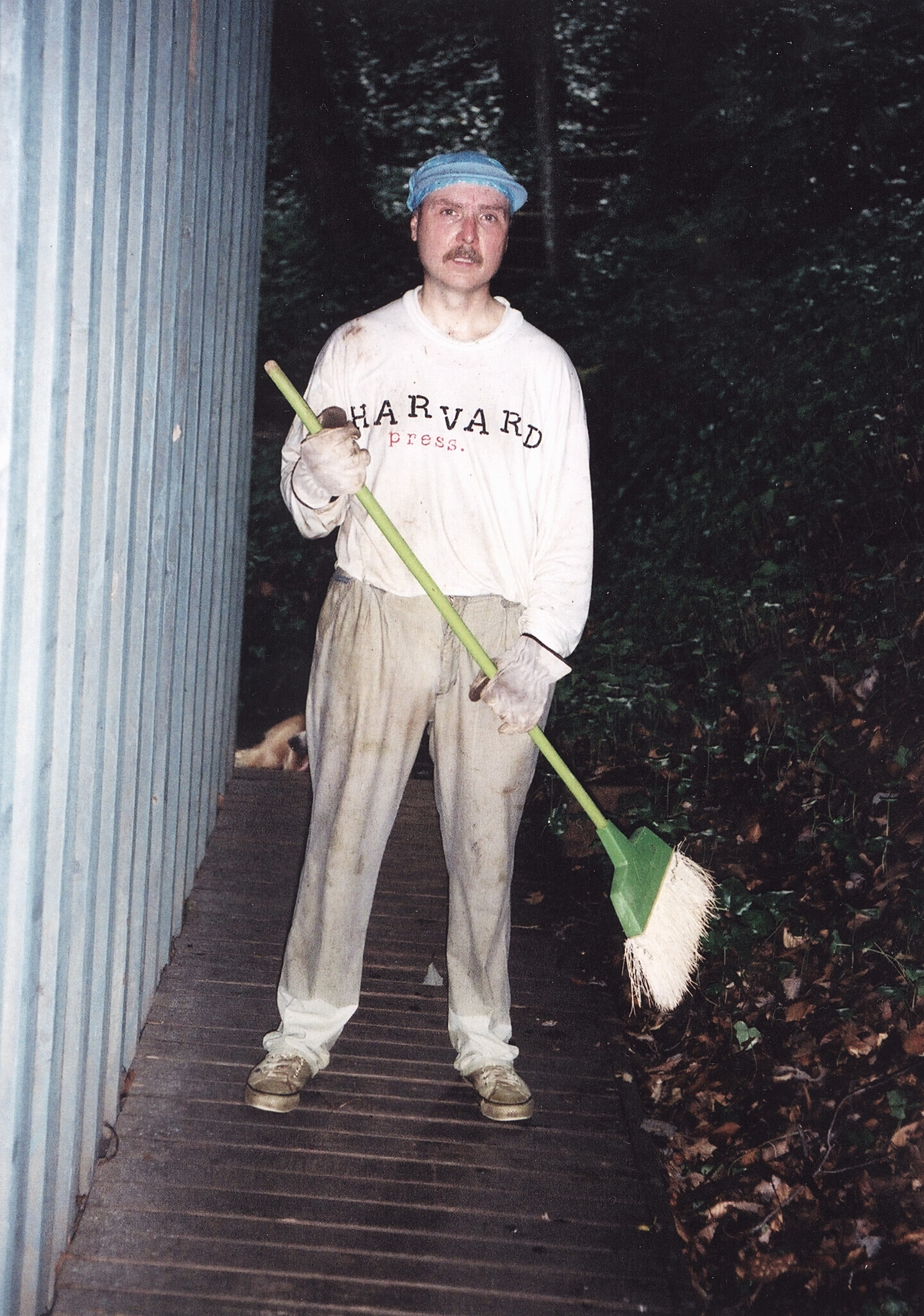
One of my favorite photos of my husband at our first home doing yard work!

One of my favorite photos of my husband at our first home doing yard work. And despite his T-shirt in this picture, he went to Vanderbilt, not Harvard!

By the time I left the university at the still-young age of 53, I had met my husband at the university, made lifelong friends there, and worked for 30 years in a place I loved and believed in. To be honest, leaving wasn’t entirely my idea. As a political organization ruled by a board appointed by Tennessee’s governors, the university is constantly buffeted by change as each succeeding board hires a president or chancellor who puts his or her stamp on the whole shebang.

When the vice president I reported to left UT, I was vulnerable and it was no longer the place of my youth where you might have a lower-paying salary than in the private sector, but you had good benefits and job security. The idea of loyalty going both ways at UT had changed during my 30 years, and the fact that I had led the communications team that made it possible for our staff to raise $1 billion for the university was ever so beside the point.

After: When you move in the Fort Sanders area, you can actually get carried away. Photo: Knoxville Mercury

One historic Victorian house in the path of the university’s expansion found a place to move, two others will be razed. Photo: Knoxville Mercury

Now when I drive through the campus, it is clear the latest administration believes tearing down older buildings and replacing them with newer ones is their ticket to climbing the national rankings. If that were true, they could backslap themselves in a few years and call it a day.

Other universities that have earned national prominence have large student centers, new student dorms, and the latest research labs. And they don’t need to raze historic campus buildings and Victorian homes to do it.

Before its destruction: the Carolyn P. Brown Memorial University Center at the University of Tennessee.

Before demolition: UT’s Carolyn P. Brown Memorial University Center built in 1962 and its old-growth trees

After: the destruction of the University Center. Photo by Laurie Knox

After: the destruction of the University Center. Photo by Laurie Knox


And their decision-makers might seek to preserve the beauty and history around them by saving old-growth shade trees when they decide to demolish a campus building.

I can only conclude that my hometown and university have come up short as they aspire to compete for a larger piece of the pie. As I read in a review by Dominique Browning in yesterday’s New York Times Book Review:

The world is astonishing, mainly because of its persistence.

The traditions and history of my hometown will continue due to the decisions made by countless people who celebrate the unique qualities of this place. In some respects, however, our traditions survive despite the decisions of people who do not share or value them.

//Anna – 8/31/2015


Posted in Autobiographical, Home, Knoxville, Op/Ed Thoughts, Work, Writing | Tagged , , , , , , , , | 2 Comments

Harper Lee’s Handlers Kill a Mockingbird

harper lee

Bestselling author Nelle Harper Lee in the 1960’s.

Ever since I read that To Kill a Mockingbird author Harper Lee’s lawyer Tonya Carter and publisher HarperCollins were planning to publish the first draft of a novel she wrote 57 or so years ago, I have been sick to death for her legacy. Lee had not deemed it appropriate to publish any of her attempts at another book for 50 years, so it has been impossible for me to believe that this 89-year-old woman who is partially blind, deaf, suffering from memory loss, and cared for in an Alabama home for the aged has suddenly decided it was time to publish another novel.

watchmanThe book entitled Go Set a Watchman went on sale today and, according to The New York Times book critic Michiko Kakutani and other critics, is a mediocre novel that depicts Mockingbird’s Atticus Finch as a racist. This would be the same Atticus Finch that was portrayed with such breathtaking dignity by Gregory Peck in his 1962-Academy-Award-winning role as the Alabama lawyer who defended a black man falsely accused of raping a white woman.

Acording to the online version of Newsweek magazine, HarperCollins says that Kakutani’s review, which appeared in the Times four days before the book’s release, was based on information from a leaked copy of the book. If the magazine’s reporting is correct, plaudits are in order to the Times for putting out the word on the novel’s contents which may lower the potential payday for HarperCollins and Harper Lee’s perfidious lawyer who seem to care more about dollar signs than about Lee’s legacy.

With a nod to Dave Letterman, I have listed below the Top 10 reasons Harper Lee’s handlers should not have published this book.

10) Go Set a Watchman was not edited for publication. The most basic reason, the book should never have been published is that no legitimate publisher would print a first draft of a book that had not been thoroughly edited in a back-and-forth manner with the author. In an interview shown during PBS’s American Masters TV show on the book’s publishing, a HarperCollins functionary said nothing was changed from Lee’s original text of Watchman which her original publisher chose not to print when it was originally submitted in 1957. Lee’s health mitigates such a possibility, so the idea of publishing should have been abandoned.

Nelle Harper Lee's sister Alice Finch Lee who died last year at the age of 103.

Nelle Harper Lee’s sister Alice Finch Lee who died in 2014 at the age of 103.

9) Lee’s handlers appear to have waited until after her sister Alice died last year to publish Watchman since it is highly unlikely that Alice would have allowed publication to go forward. Alice, an attorney who practiced law until just before her death in 2014 at the age of 103, had always acted to protect her younger sister’s best interests and legacy.

8) Decades ago Nelle Harper Lee decided to have nothing to do with living a public life. After To Kill a Mockingbird was published in 1960 and became a bestseller, Lee granted interviews and was involved in the making of the movie version of her book. However, after a few years she became disenchanted with the media hubbub, made it clear she wanted to live a quiet life with no publicity, and has not granted an interview since 1964.

Lee with Mary Badham who played Scout in the movie version of To Kill a Mockingbird.

Lee with Mary Badham who played Scout in the movie version of To Kill a Mockingbird.

7) Lee’s age and health have diminished her ability to act wisely on her own behalf. Nelle suffered a stroke in 2007 that left her bound to a wheelchair, nearly blind, deaf, and with memory loss. Although the state of Alabama investigated and eventually dismissed elder abuse and coercion charges earlier this year, it is clear that Lee’s ability to make discerning decisions to protect her legacy have been seriously diminished.

6) As a likely beneficiary of Lee’s estate, Tonya B. Carter, Lee’s lawyer, stands to inherit more money if she allows publication of Go Set a Watchman, along with a third novel that Nelle Harper Lee in her prime chose not to have published. Carter said she only last year “discovered” in Lee’s safe deposit box the Go Set a Watchman text that had been “lost” for half a century. However, Carter’s veracity has been called into question by two men who were asked to view the safe deposit box’s contents in 2011 to appraise Watchman as the original draft for Mockingbird along with some other valuable documents.

Mary Badham as Scout and Gregory Peck as Atticus in the movie version of To Kill a Mockingbird.

Mary Badham as Scout and Gregory Peck as Atticus in the movie version of To Kill a Mockingbird.

5) Instead of being a paragon of justice in a racist Southern town as in Mockingbird, Atticus Finch–and by extension, Lee’s father A.C. who was her inspiration for the character–are portrayed in Watchman as racist defenders of segregation. Lee’s first draft of a novel (Watchman) was about a young woman coming home to Alabama after living in New York to find the father she once idolized was a bigot and racist who was against desegregation. Editor Tay Hohoff at J. P. Lippencott, Lee’s original publisher, advised her to rewrite the story from the viewpoint of the young woman as a child growing up in the Depression-era South. Nelle Harper and Alice Lee’s father A.C. Lee was an Alabama lawyer and state legislator who had defended two black men accused of murdering a white storekeeper. Lee said she modeled Atticus Finch after her father.

Brock Peters as Tom Robinson and Gregory Peck as Atticus Finch in To Kill a Mockingbird.

Brock Peters as Tom Robinson and Gregory Peck as Atticus Finch in To Kill a Mockingbird.

4) It is always the better part of valor not to add a coda to a masterpieceIn 1961 To Kill a Mockingbird won the Pulitzer Prize for fiction, it has never been out of print, and has an estimated 30 million copies in print. Although the book has been banned through the years in some school districts for its subject matter, it has been read and studied by school children throughout the U.S. (and the world) as an example of understanding and overcoming prejudice, standing up for what you believe when it is not popular or may even be dangerous, and the simple dignity of two men–one black (Tom Robinson) and one white (Atticus Finch)–standing together against hatred, ignorance, prejudice, and racism.

3) The new book’s publication calls into question how much of Lee’s masterpiece was attributable to her writing ability and how much was due to the insights of her editor. After she read Lee’s original draft of Watchman, Hohoff said the book “was more a series of anecdotes than a fully realized novel.” She commented, however, that “the spark of the true writer flashed in every line.” It would have been vastly more prudent to allow Mockingbird to stand on its own achievements without this microscopic view of its birthing process.

50th anniversary edition mockingbird2) Harper Lee decided decades ago that she could not improve on her first novel and that any additional attempts to do so would be fruitless. Mockingbird was Nelle Harper Lee’s story to tell, and she told it beautifully and well. Her handlers should have acted on what was best for Nelle Lee and her legacy not their own selfish interests.

1) You should never kill a mockingbird. As Harper Lee wrote,

Atticus said to Jem one day, ‘I’d rather you shot at tin cans in the backyard, but I know you’ll go after birds. Shoot all the blue jays you want, if you can hit ‘em, but remember it’s a sin to kill a mockingbird.’ That was the only time I ever heard Atticus say it was a sin to do something, and I asked Miss Maudie about it. ‘Your father’s right,’ she said. ‘Mockingbirds don’t do one thing except make music for us to enjoy. They don’t eat up people’s gardens, don’t nest in corn cribs, they don’t do one thing but sing their hearts out for us. That’s why it’s a sin to kill a mockingbird.’

Harper Lee sang her heart out for us through the voices of Scout and Atticus Finch in To Kill A Mockingbird. That song was pure, rang true, and touched the hearts of other mockingbirds throughout the world. That story was full in the telling and, as we say in the South, should have been let alone.

//Anna – 7/14/2015

Posted in Books, Op/Ed Thoughts, Screen, Uncategorized, Writing | Tagged , , , , , , , , , , , , , , , , , , | Leave a comment

Losing Our Religion in the Wild Cow

In January of this year, my husband Kurt and I visited the fiercely happening metropolis of Nashville, Tennessee. As we waited for our food at a little vegetarian eaterie in East Nashville called the Wild Cow, REM’s classic “Losing My Religion”, came on over the restaurant’s sound system and the rest, as they say, is history . . .


Posted in Blooming, Creativity, Music, Tribute, Uncategorized | Tagged , , , | Leave a comment

Thunder Still Rolling in the Mountains

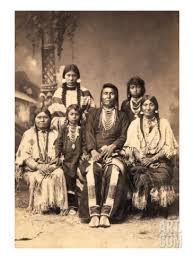
Thunder Rolling in the Mountains (Joseph) and his family in 1880.

Thunder Rolling in the Mountains (also known as Chief Joseph) and his family in 1880.

Perhaps because they lived so close to the natural world and recognized kindred spirits and sacredness in everything around them, the words of wise Native Americans echo through the ages with the same truth they carried when they were first said.

When we were in New York City last week, my husband and I visited the Smithsonian’s New York version of the Museum of the American Indian. One of the exhibits we saw featured the words of Chief Joseph of the Niimíipuor (pronounced nee mee poo) or the Nez Perce as they were commonly known. In their language, they called themselves “The People”, and they once lived in what is now Washington, Oregon, Montana, and Idaho.

Thunder Rolling in the Mountains of the Nez Perce people.

Thunder Rolling in the Mountains of the Nez Perce people.

Native Americans named each member of their tribe according to his or her own special qualities. In his language, Chief Joseph’s name was Hin mah too yah lat kekt which meant Thunder Rolling in the Mountains. His words from 1879 resonate for us today in a world and a country filled with divisions, strife, hatred, and old enmities nursed for hundreds, sometimes thousands, of years.

Hear the truth in the words of Thunder Rolling in the Mountains, chief of the Nez Perce people who fought the U.S. Army to live on their homelands:

If the White Man wants to live in peace with the Indian, he can live in peace. There need be no trouble. Treat all men alike. Give them the same law. Give tham all an even chance to live and grow. All men were made by the same Great Spirit Chief. They are all brothers. The Earth is the Mother of all people, and all people should have equal rights upon it.

//Anna – 5/10/2015

Posted in Courage, Freedom, Ideas, Op/Ed Thoughts | Tagged , , , , , , , , | Leave a comment

The Fortunetellers in Our Heads

Singer/songwriter Angel Snow

Singer/songwriter Angel Snow

Most mornings when I get up, music is already playing in my head. Snippets of songs, a phrase that hangs with me. I can’t tell sometimes whether the song has a significance for me at that moment–my subconscious trying to tell me something–or if the song is the just last one I heard the day before.

The song that has been haunting me for awhile is Coals and Water, written by the perfectly named singer Angel Snow.

Verse: Fortune Tellers dancing ’round inside my head
I’m trying not to lose everything she said
Even saw one standing at the foot of my bed
last night
This mountain’s gettin’ higher with every step
I’m trying not to lose everything I’ve kept
Captured by the fortune tellers in my mind

CHORUS: Ooohh. They always come back again
Every time freedom tries to pull me out they suck me back in
Oohh. You gonna let that fire burn you
Tell me how you gonna walk on coals and water too?

2014-08-19 13.41.32There is a story we tell ourselves each day–a script maybe started by others–do I hear Mama shaming me for not sitting still in church? The playback continues in a monotonous loop in our heads. When I leave my cellphone somewhere in the house for the umpteenth time and have to waste time looking for it, I tell myself, “Silly girl!” When I’m running late–again!–do I forgive myself as I would a dear friend who has too much on her plate? Sometimes I do, sometimes not.

Sometimes what I tell myself becomes reality, the seer of my fortune. Yes, when I worry I’ll drop that plate, sometimes I do. A self-fulfilling prophecy.

Boyd (Walton Goggins), Ava (Joelle Carter), and Raylon (Timothy Oliphant) of AMC's "Justified".

Boyd (Walton Goggins), Ava (Joelle Carter), and Raylon (Timothy Oliphant) of “Justified”.

I think the first time I heard Angel Snow’s song was on my favorite TV show, FX’s “Justified” (that just finished its final season). This vastly underrated tribute to the amazing writer Elmore Leonard’s conjuring of characters tells the story of three people trying to find a life outside the poverty, crime, and coal-mining grind of Harlan County, Kentucky. Can they escape from the soul-crushing hopelessness that planted outposts in their heads when they were children? Can they “walk on coals and water too”?

justified coatAll I asked when my beloved “Justified” was coming to an end, was that the show’s producers, writers, and directors be true to the characters, Elmore Leonard’s lacerating wit, and his incredible writing. I guess I took it personally because their story seemed like my own. Hey, I grew up poor in East Tennessee, not too far from Eastern Kentucky. Heck, my hometown of Knoxville was even mentioned in a “Justified” show.

[Spoiler aside: in the finale, the “Justified” crew did their usual fantastic job and left us missing them already.]

Although no one I personally knew when I was growing up sold drugs or killed anyone, it is not easy to be born poor in a country that prizes money over all things. The new script in my head is simply to be true to myself, enjoy this crazy-adventure, tilt-a-whirl life, and take notes for my writing, because there is never any piece of fiction that can measure up the wacky-crazy things that go on in real life.

I’m not sure I will ever get out of my own personal Harlan alive. But sometimes you just have to plant a tree in your own backyard and watch it grow.

//Anna – 5/1/2015

Posted in Autobiographical, Courage, Writing | Tagged , , , , | 2 Comments

All the Blogposts I Didn’t Write

Yes, I have been spending too much eating, sleeping, dashing about, and in general thinking about, but not writing, blogposts. Guilty, guilty, guilty as charged. Here are just a few of the blogposts I didn’t write:

amazon loreenaDivine Celtic and Eastern Music – I recommend that you listen to glorious Canadian artist Loreena McKennitt, the musician, composer, and peerless soprano who my husband and I love so much that we traveled to Montreal to see her–only to find that later in that same tour she was coming to our hometown of Knoxville, Tennessee! The first time we saw Loreena live was at Radio City Music Hall in New York City while we were on our way to Europe. Pure magic! She rarely tours so we thought this would be our only chance to see her.

ancient museLoreena plays the harp, accordion, and keyboards, writes the most sublime Celtic and Middle Eastern music, and performs with musicians that play the ancient instruments that make her songs come alive.

When Loreena came to Knoxville, she played in our 1920’s-era movie palace, the Tennessee Theatre, an acoustically perfect space designed in a Spanish-Moorish style that beautifully complimented her tribal rhythms.

tell meWhen I hear her music, I travel back to Elizabethan times and bow to my partner in a courtly dance. In another song, our caravan passes through the desert and stops for the night with lanterns hanging from the tents, and music swirling like smoke around the campfire. Loreena creates a world and invites us in.

Check out the sheer delights of her songs Brian Boru’s March, The Old Ways, SantiagoMarco Polo, and The Star of the County Down, and see where you travel.

Nabobs and Noohoos – the blogpost I didn’t write where I call out politicians at all levels of government (local, state, and national) who are making mindless concessions to monied interests, arguing over which legislative body will cross the street first, and eating hot dogs with their constituents when they are up for re-election, but not getting any bills passed through their various political bodies. They are totally clueless.

birdman

Michael Keaton, shown here with his alter ego in the movie Birdman, winner of this year’s Academy Award for Best Picture. My take: it is the weakest movie ever to win the big prize, is incoherent, and barely watchable.

Birdman, Birdpoop, and Other Oscar Musings – in this post I wonder aloud how many years the Academy of Motion Picture Arts and Sciences can study its collective navels and crown movies best picture that are totally unwatchable. Yes, I am talking about the movie Birdman, which is one of the worst movies I have ever suffered through, and yet it inexplicably won the Best Picture Oscar this year. I am one of the 25 stuuu-pid people outside Hollywood film circles who saw the movie.

I love art house films, can’t get enough of subtitles, love documentaries, but pull-leazzzzee, Oscar voters, find another way to pat each other on the back for memorizing long paragraphs of pointless dialogue and shooting it in one take (whee!) instead of making coherent movies we actually want to see. Phew, got that off my chest about a month too late, but it feels good anyway!

50/30/20 – here’s the post where I share what my allergist/immonologist told me is the percent of food we are supposed to eat at each daily meal. As my doctor explained, our bodies are primed and ready for fuel when we wake up, our digestive organs ready to take in food. Thus, our first meal, breakfast, is where we should eat 50 percent of our daily food, with 30 percent eaten at lunch, and 20 percent at dinner. When the sun goes down, our bodies naturally respond by shutting down the digestive process, so eating the biggest meal late in the day is not the best choice for our health, for sleeping well, or for optimum weight management. I haven’t gotten even close to following his advice, but I am trying.

Quanah Parker, the only man ever to hold the title of chief of all the Comanche people.

Quanah Parker, the only man ever to hold the title of chief of all the Comanche people.

The Empire of the Summer Moon: Quanah Parker and the Rise and Fall of the Comanches, the Most Powerful Indian Tribe in American History – last week I finished this uniquely satisfying book by gifted writer S. C. Gwynne which tells the true story of the lifeways of the Comanche people, the most feared native tribe in North America, and the tribe that fought white domination the longest and most successfully. It is also the unbelievable story of Quanah, the half-white and half-Native American man, whose white mother, Cynthia Ann Parker, was captured by the Comanches when she was 9 years old.

quanah parkerUsually a half-white Comanche would not have been a chief, but Quanah won the leadership role on the open plains by being the fiercest, most intelligent, and more courageous warrior of all the Comanches in his tribe. And yet, this chief, who no doubt scalped countless enemies of his people, not only became friends with U.S. President Teddy Roosevelt, but counted his greatest legacy in how he led the Comanches after they entered reservation life with his unerring political acumen, boundless optimism, and generosity to all his people. And speaking of Teddy Roosevelt . . .

Theodore Roosevelt giving "them" hell.

Theodore Roosevelt giving “them” hell.

Teddy Roosevelt/Franklin Delano Roosevelt – in this post I would have shared my intense and beautiful love for all things Roosevelt! Teddy was rambunctious, used his bully pulpit to call out the rich and powerful nabobs and noohoos who got in the way of his policies, and created national parks and conservation areas that we enjoy to this day. Franklin Roosevelt saved our country from financial ruin; gave Americans a way to live their retirement years with shelter, food, and dignity with Social Security; and defeated fascism and Hitler.

The Roosevelts both used government for the good of the American people–how breathtakingly simple and yet profound. Both Roosevelts came from the monied aristocracy (though TR was not from the wealthier branch of his family) and were hated for turning their backs on their kind by helping the poor and middle class. Could we have more of that, please! We need another Roosevelt: a true leader for the 21st Century would be beyond my wildest hopes, but sometimes leaders come at the moment we need them.

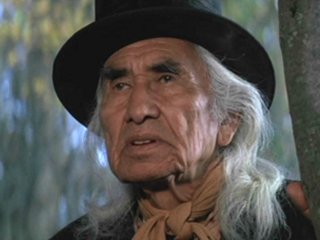
Chief Dan George in "The Outlaw Josey Wales", 1975

Chief Dan George in “The Outlaw Josey Wales”, 1975

In this vein, I give the last word to one of my favorite Native American actors, Chief Dan George, who said, “Endeavor to persevere,” in the seminal Clint Eastwood Western of my young womanhood, The Outlaw Josey Wales. I can’t count how many times I have quoted those words during my lifetime.

Here’s the story as Dan George’s character, Lone Watie, so eloquently told it in the film:

I wore this frock coat to Washington before The War. We wore them because we belonged to the five civilized tribes. We dressed ourselves up like Abraham Lincoln. You know, we got to see the Secretary of the Interior. And he said, “Boy, you boys sure look civilized.” He congratulated us, and he gave us medals for looking so civilized.

We told him about how our land had been stolen and how our people were dying. When we finished he shook our hands and said, “Endeavor to persevere!” They stood us in a line: John Jumper, Chili McIntosh, Buffalo Hump, Jim Buckmark, and me—I am Lone Watie. They took our pictures. And the newspapers said, ‘Indians vow to endeavor to persevere.’

We thought about it for a long time. ‘Endeavor to persevere.’ And when we had thought about it long enough, we declared war on the Union.

I couldn’t say it better myself!

//Anna ~ 3/27/2015
 

Posted in Books, Courage, Food, Happiness, Music, Op/Ed Thoughts, Screen, Travel, Uncategorized, Writing | Tagged , , , , , , , , , , , | 4 Comments